
Twelve Point Six
GILTI is now net CFC tested income. For a corporate owner, the number that sets the 2026 bill is 14 percent: the blended foreign rate, measured the U.S. way, at which credits cover the tax. Below it, the low-taxed plant writes the bill.
Under NCTI, the low-taxed subsidiary generates the U.S. tax and the high-taxed one’s spare credits cover it. Split them, and a corporate owner pays.
“The taxing authority is an uninvited party to all contracts.”
Myron Scholes et al., Taxes and Business Strategy, 5th ed.
For taxable years beginning after December 31, 2025, the 2025 Act renamed global intangible low-taxed income (GILTI) “net CFC tested income” (NCTI), struck the 10 percent deemed return on tangible assets, set the §250 deduction at 40 percent (a 12.6 percent rate for a C corporation before credits), raised the deemed-paid credit from 80 to 90 percent of foreign tax, and took interest and research expense out of the NCTI foreign tax credit basket.1 Treasury has since proposed three sets of rules: in August, on the haircut for taxes on repatriated earnings and on who includes what when a controlled foreign corporation (CFC) changes hands (comments due October 26); and in September, on expenses in the NCTI basket (comments due November 10). The IRS’s 2026–2027 Priority Guidance Plan, released September 29, puts final versions of all of them on this year’s agenda.
This alert works one portfolio: a capital-heavy plant taxed at 9 percent abroad and a light-asset software company taxed at 25 percent. The group’s inclusion rises 79 percent and its residual U.S. tax rises from $252,000 to $360,000. On its own, the plant’s residual U.S. tax triples, from $446,000 to $1.35 million; its software sister’s spare credits are what hold the group to $360,000. We test the expense proposals on the same numbers, flag the states that part from the federal math, and close with three decisions for 2026 models. Run the numbers before the December estimate; it will not wait for final regulations.
Most U.S. groups of any size now own something abroad: multinationals and family businesses through their own subsidiaries, investors through the platforms sponsors built over the past decade. From 2018 through 2025, GILTI exempted a 10 percent return on the CFCs’ tangible assets and taxed the rest at 10.5 percent for a U.S. corporation, before credits. A plant with a large balance sheet in a low-tax country often owed little or nothing.
That shelter is gone. The inclusion is now all of the CFCs’ net tested income, the deduction is smaller, and the credit is bigger. The headline rate is 12.6 percent. By itself it settles very little. What decides a corporate owner’s bill is the 14 percent foreign rate at which credits cover the tax, tested across the shareholder’s CFCs in one basket for one year, subject to tested losses and the credit limitation, with no carryover.
Our thesis: under NCTI, the low-taxed subsidiary generates the U.S. tax, and the high-taxed one’s spare credits cover it. The capital-heavy plant lost the most, because QBAI used to shelter it. For a corporate owner, an election or structure that separates the two costs money whenever the low-taxed one needed those credits.
NCTI (formerly GILTI). Net CFC tested income: a U.S. shareholder’s share of its CFCs’ tested income, less their tested losses. Before 2026 it was global intangible low-taxed income (Section 01).
CFC and U.S. shareholder. A controlled foreign corporation is a foreign company more than 50 percent owned, by vote or value, by U.S. shareholders: U.S. persons that own 10 percent or more of its vote or value, after attribution (Sections 01 and 06).
QBAI. Qualified business asset investment, the tax basis of a CFC’s depreciable tangible property. Before 2026, a 10 percent return on it was exempt; Minnesota still uses it (Sections 01 and 05).
§250 deduction. The deduction a U.S. corporation takes against NCTI and the related §78 gross-up: 40 percent from 2026, which leaves a 12.6 percent rate before credits (Section 02).
Deemed-paid credit and inclusion percentage. The credit for 90 percent of the CFCs’ foreign taxes on tested income, scaled down by the inclusion percentage when tested losses (or, before 2026, QBAI) shrink the inclusion (Section 02).
The NCTI basket. The separate foreign tax credit limitation category for NCTI. Credits in it offset only that year’s NCTI and cannot be carried to another year (Sections 02 and 04).
PTEP. Previously taxed earnings and profits: CFC earnings a U.S. shareholder has already included, which generally come out later without a second regular tax (Section 06).
FDDEI. Foreign-derived deduction eligible income, the base for the 33.34 percent export deduction under §250 (Section 04).
Executive summary
The tangible-asset shelter is gone. Former §951A(b) and (d), the net deemed tangible income return and qualified business asset investment (QBAI), were struck for taxable years beginning after December 31, 2025. Every dollar of net tested income is now included (Section 01).
12.6 percent before credits; 14 percent to break even. A 40 percent §250 deduction and a 90 percent deemed-paid credit mean that foreign tax of 14 percent of pre-tax income wipes out the residual U.S. tax, for a corporate owner with no tested losses and nothing but the §250 deduction in the basket. Under 2025 rules the crossover was 13.125 percent; under the schedule the 2017 Act set for 2026, it would have been 16.4 percent (Section 02).
Interest now stays home. New §904(b)(5) keeps interest and research expense out of the NCTI basket, which raises the credit limitation (Section 02).
Overhead stays home too, if the proposals hold. Proposed regulations treat stewardship, legal, accounting, and G&A as not “directly allocable”; what the ordinary rules would have charged to the NCTI basket moves to U.S.-source income. Where the limitation binds, each $1 million moved is worth $210,000 of credit. Comments are due November 10 (Section 04).
The mix hides a transfer. In our Northline example, the low-tax plant alone would owe $1.35 million of residual U.S. tax in 2026, three times the $446,000 it would have owed alone under 2025 rules. The high-tax affiliate’s $990,000 of excess credits bring the group back to $360,000 (from $252,000 in 2025, a figure that assumes $1.2 million of parent interest in the basket; without it, about $22,000). A high-tax election for the affiliate, or its sale before 2026 begins, strips those credits and costs a corporate owner $990,000. The answer differs for individual owners and in some states (Sections 03 and 06).
The states did not sign up for the federal math. Iowa excludes NCTI for corporations but taxes all of it for individuals, and ignores §962 elections. Minnesota kept a QBAI-based subtraction, subject to a statutory cap, so you cannot stop tracking it. Other states legislated too (Section 05).
The investor’s seat sets the bill. Per $100 of the plant’s pre-tax income, a corporate shareholder holding 10 percent or more pays $13.50 of foreign and U.S. tax in total; an individual holding 10 percent or more without a §962 election pays $42.67 now and $3.46 of net investment income tax (NIIT) later. Where the fund holds the CFC directly, a corporate LP that is not itself a U.S. shareholder (below 10 percent after attribution) includes nothing currently (Section 06).
Partnership tax packs change in 2026. Inclusions follow days owned. Ten percent of the foreign tax on distributions of earnings from §951A inclusions in shareholder years ending after June 28, 2025 (for calendar-year owners, all of 2025) is disallowed. Minnesota filers still need QBAI (Section 06).
01 What changed on January 1
Section 951A still requires each U.S. shareholder of a CFC to include an amount each year. The amount is now “net CFC tested income”: the shareholder’s pro rata share of its CFCs’ tested income, less its share of their tested losses (§951A(b)(1)). Tested income is still defined as before, so it still excludes Subpart F income, related-party dividends, and income excluded by the high-tax exception (§951A(b)(2)(A)(i)). What went away is the subtraction for a 10 percent return on qualified business asset investment, the adjusted basis of the CFCs’ depreciable tangible property.
| Item | 2025 (GILTI) | 2026 (NCTI) | Authority |
|---|---|---|---|
| Inclusion | Net tested income less (10% of QBAI minus specified interest expense) | Net tested income | §951A(a), (b)(1); P.L. 119-21 §70323 |
| §250 deduction (C corporations) | 50% | 40% (the 2017 Act had scheduled 37.5%) | §250(a)(1)(B); §70321 |
| Rate before credits | 10.5% | 12.6% (13.125% under the 2017 schedule) | 21% × (1 − deduction) |
| Deemed-paid credit | 80% of foreign tax × inclusion percentage | 90% of foreign tax × inclusion percentage | §960(d)(1); §70312 |
| §78 gross-up | 100% of deemed-paid tax (foreign tax × inclusion percentage), no 80% haircut; includes §960(b) taxes | Same, no 90% haircut; §960(b) taxes on distributions of previously taxed earnings no longer grossed up | §78; §70312 |
| Expenses allocated to the basket | Interest and some other expense apportioned; research expense already excluded by regulation | §250 deduction and related taxes; other deductions only if directly allocable; no interest or research expense | §904(b)(5); Treas. Reg. §1.861-17(d)(1)(iv); Prop. Treas. Reg. §1.904(b)-4 |
| Taxes on distributions of §951A earnings | No disallowance for earnings from inclusions in shareholder years ending on or before June 28, 2025 | 10% of otherwise creditable tax disallowed for earnings from inclusions in shareholder years ending after June 28, 2025; applied pool by pool, so it already reaches 2025 calendar-year inclusions | §960(d)(4); Notice 2025-77; Prop. Treas. Reg. §1.960-3(b)(6) |
| Who includes | Owner on the last day in the CFC year on which it was a CFC | U.S. shareholders, for the days on which they own stock under §958(a) while both U.S. shareholder and CFC status exist (§956 inclusions still use a last-day rule) | §951(a)(1)(A), (a)(2)–(3); §951A(c)(1)–(2) |
Exhibit 1. GILTI to NCTI, line by line. Source: Code sections as cited, as amended by P.L. 119-21; La Presa analysis.
Two timing points. First, NCTI applies by the shareholder’s year, but the new pro rata rules apply by the CFC’s year. The NCTI amendments take effect for “taxable years beginning after December 31, 2025”; the August 26 preamble reads that as the U.S. shareholder’s year, while the pro rata amendments speak to foreign corporations’ years. So a CFC year that begins in 2026 but ends inside a parent year that began in 2025 (a January–June 2026 short year in a July–June parent year, for example) still produces GILTI, with QBAI, under the new pro rata rules. A full calendar-2026 CFC year ordinarily falls in that parent’s next year, under NCTI. Map each pair of years before year-end. Second, the one-month deferral election under §898(c)(2) is gone for CFC years beginning after November 30, 2025, which left some groups with a one-month 2025 short year. Notice 2025-72 describes how foreign taxes will be split around it, and the August 3 proposals would write that rule into the regulations (Prop. Treas. Reg. §1.898(c)-1). Notice 2025-75 explains how the statutory transition rule applies to dividends paid in a CFC’s pre-2026 year.
Effective dates. Section 70322(a), which takes gain on certain dispositions out of deduction eligible income, applies to dispositions after June 16, 2025. The other NCTI changes apply to taxable years beginning after December 31, 2025 (for §960(d)(4), see Section 06), and the ownership changes in §§70353 and 70354 apply by the foreign corporation’s year.
02 Why 12.6 is not the number
Twelve point six percent, the title of this alert, is what a U.S. corporation pays on NCTI before foreign tax credits: 21 percent on the 60 percent of the inclusion left after the 40 percent §250 deduction. The number that sets the bill is a different one.
Take $100 of pre-tax income earned by a CFC that pays foreign tax at rate t. A U.S. corporate shareholder includes the after-tax $100 − t, grosses it up by the tax, and is back at $100 of gross income. The §250 deduction takes $40. Tax at 21 percent on the remaining $60 is $12.60. The credit is 90 percent of the foreign tax. The residual U.S. tax is therefore $12.60 − 0.9t, and it reaches zero when t is 14 percent.
That crossover is the number to put in the model. On a clean $100, with no QBAI and no expenses, it moved from 13.125 percent under 2025 rules (50 percent deduction, 80 percent credit) to 14 percent. For many groups the move cut the other way: apportioned interest had pushed their 2025 break-even well above 13.125 percent. Had the 2017 Act’s schedule taken effect in 2026 (37.5 percent deduction, 80 percent credit), the crossover would have been 16.4 percent. For a CFC taxed at 10 percent, the 2025 Act’s rules produce $3.60 of U.S. tax per $100; the 2017 schedule would have produced $5.13.
“Otherwise lost” is the part that shapes structure. NCTI-basket credits cannot be carried back or forward (§904(c), last sentence). They can only offset U.S. tax on other NCTI of the same shareholder in the same year. A 25 percent affiliate produces $22.50 of credit against $12.60 of tax on its own income; the other $9.90 is worth something only if a low-taxed affiliate needs it. Taxes of a CFC with a tested loss earn no §960(d) credit (taxes on any separate Subpart F income need their own analysis), and a tested loss elsewhere in the group scales down the other CFCs’ credits through the inclusion percentage (§960(d)(2)–(3)).
Per $100 of a CFC’s pre-tax income, a U.S. corporation owes $12.60 before credits and gets 90 cents of credit for each dollar of foreign tax. Below a 14 percent foreign rate, it pays the difference. Above it, the extra credit can shelter low-taxed income of other CFCs in the same year, and is otherwise lost.
The 14 percent is foreign tax over income as the U.S. measures it, not the local statutory or book effective rate. Timing differences (stock compensation is a common one), a narrower local base, and prior-year adjustments can put a CFC with a 16 percent book rate below the line.2 And the rule is a corporate one: an individual without a §962 election gets no deemed-paid credit at all. It also assumes fully creditable foreign taxes, an inclusion that is entirely foreign-source income in the NCTI basket, the full §250 deduction, no tested losses, and no other deduction, loss, or recapture that restricts the credit.
The limitation itself got more generous. Under new §904(b)(5), the only deductions that reduce foreign-source income in the NCTI basket are the §250 deduction, the §164(a)(3) deduction for income taxes on that income, and other deductions “directly allocable” to it. The statute then says the basket gets “no amount of interest expense or research and experimental expenditures,” and anything displaced is allocated “only” to U.S.-source income. Research expense was already kept out of the basket by Treas. Reg. §1.861-17(d)(1)(iv). The change that matters is interest: a leveraged U.S. parent that used to lose a slice of its GILTI credits to apportioned interest now keeps them. What “directly allocable” includes was the open question. Proposed regulations issued September 11 answer it narrowly: stewardship, legal and accounting fees, and overhead are out (Section 04).
One thing did not change. The §250 deduction is still limited by taxable income (§250(a)(2)): if the NCTI inclusion (plus any export income) exceeds taxable income before the deduction, the excess comes off the base. The §78 gross-up sits outside that comparison, so it acts as a cushion; a parent’s other losses must exceed its gross-up before the deduction shrinks. And an NOL that absorbs the inclusion strands that year’s NCTI credits for good, because they cannot be carried over. Leveraged parents should also know that NCTI, Subpart F inclusions, and the related gross-up (net of the matching §250 and §245A deductions) no longer count toward §163(j) adjusted taxable income (§163(j)(8)(A)(vi), from §70342).
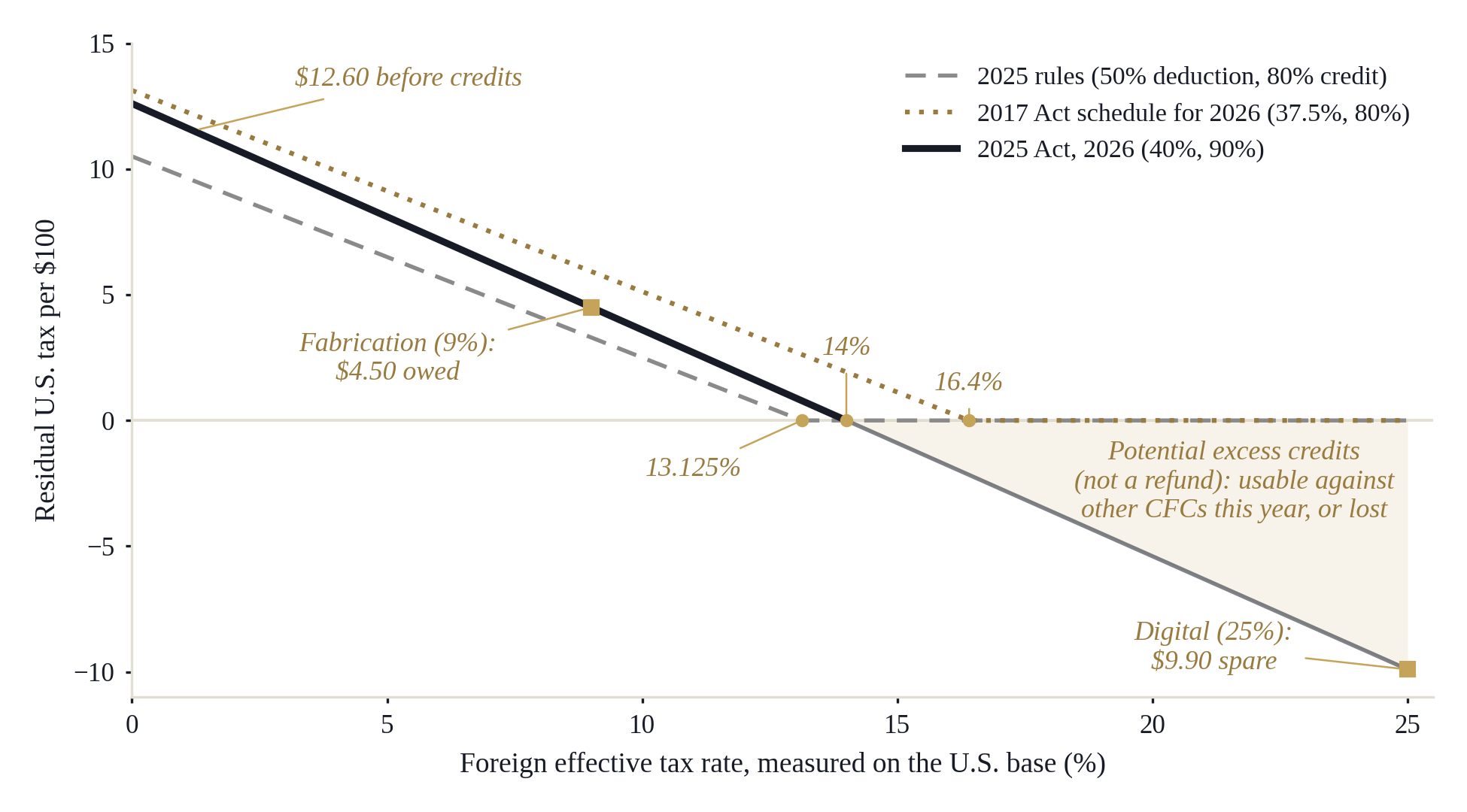
Exhibit 2. Residual U.S. tax per $100 of CFC pre-tax income, by foreign effective rate, for a U.S. corporate shareholder. Below zero, the shaded area is potential excess credit, not a refund: it shelters other CFCs’ NCTI in the same year, or it is lost. Assumes no QBAI and no expenses allocated to the basket. Source: §§250, 960, 78 as amended; La Presa computation.
03 Worked portfolio: Northline
The parties are invented and the figures are rounded; this is a template, not advice. Readers of our recent alerts have met them. Harbor Fund IV, L.P. owns 100 percent of Northline Parent, Inc., a calendar-year Delaware C corporation, whose U.S. business runs through Northline Services LLC, a disregarded entity. Northline has since grown abroad, and Parent now owns all the stock of two CFCs.
| Input ($ millions) | Northline Fabrication | Northline Digital |
|---|---|---|
| Business | Capital-intensive plant | Software and services |
| Pre-tax income | 30.0 | 10.0 |
| Foreign effective tax rate | 9% | 25% |
| Foreign income tax | 2.7 | 2.5 |
| Tested income (after foreign tax) | 27.3 | 7.5 |
| Average tangible asset basis (QBAI) | 150.0 | 4.0 |
Exhibit 3. Northline inputs. Assumptions: no CFC-level interest expense, no Subpart F income, no high-tax election unless stated, no directly allocable deductions in the NCTI basket; under 2025 rules, $1.2 million of Parent’s interest expense was apportioned to the GILTI basket; Northline Services’ U.S. income keeps Parent’s taxable income from other sources positive, so §250(a)(2) does not bite. Assuming no CFC-level interest flatters the size of the change: under 2025 rules, specified interest expense would have shrunk the QBAI return.
| Northline Parent ($ thousands) | 2025 rules (GILTI) | 2026 rules (NCTI) |
|---|---|---|
| Tested income, both CFCs | 34,800 | 34,800 |
| Less 10% return on QBAI | (15,400) | — |
| §951A inclusion | 19,400 | 34,800 |
| Inclusion percentage | 55.7% | 100% |
| §78 gross-up | 2,899 | 5,200 |
| Gross income | 22,299 | 40,000 |
| §250 deduction (50% / 40%) | (11,149) | (16,000) |
| Taxable inclusion | 11,149 | 24,000 |
| U.S. tax before credits (21%) | 2,341 | 5,040 |
| Interest apportioned to the basket | 1,200 | — |
| Credit limitation | 2,089 | 5,040 |
| Deemed-paid credit (80% / 90%) | 2,319 | 4,680 |
| Credit allowed | 2,089 | 4,680 |
| Residual U.S. tax | 252 | 360 |
| Credits lost | 230 | — |
| Foreign plus U.S. tax, as % of $40.0 million | 13.6% | 13.9% |
Exhibit 4. Northline, before and after. Figures computed in Python from the inputs in Exhibit 3 and rounded to the nearest $1,000; columns may not foot because of rounding. Residual U.S. tax here, and in Exhibits 5 and 6, is the tax on the inclusion and gross-up after the §250 deduction, less allowed credits; it excludes tax on Parent’s domestic business and the separate value of Parent’s deductions. Source: La Presa computation.
The inclusion rises 79 percent. The residual U.S. tax rises 43 percent, to $360,000. Measured against total tax on $40 million of pre-tax income, the change is small: 13.6 percent to 13.9 percent. Against the law that would have applied in 2026 without the 2025 Act (37.5 percent deduction, 80 percent credit, QBAI intact), Northline would owe $608,000. (The $1.2 million of interest would not change that figure: under that schedule the limitation, about $2.67 million, exceeds the $2.32 million credit either way.) For this portfolio the new regime is cheaper than the old schedule.
That comparison flatters the portfolio. On its own, Fabrication would owe about $801,000 under the old schedule and $1.35 million under the new one. And the 2025 baseline leans on the $1.2 million of interest we assumed: without it, Northline’s 2025 bill would have been about $22,000, and its total tax 13.1 percent of pre-tax income. Take the changes one at a time, in that order, and the interest relief saves about $230,000, the new deduction and credit rates add about $178,000, and the lost QBAI return adds about $159,000. Another order gives other shares, because the 2025 limitation was binding.
The totals hide the transfer. Split the portfolio and look at each company alone:
| Residual U.S. tax ($ thousands) | 2025 rules | 2026 rules |
|---|---|---|
| Fabrication alone | 446 | 1,350 |
| Digital alone | 0 (899 of credits lost) | 0 (990 of credits lost) |
| Both, as owned (Exhibit 4) | 252 | 360 |
| Both, high-tax election in effect for Digital | 446 | 1,350 |
Exhibit 5. Where the tax comes from. Stand-alone rows assume no parent expense in the basket; the high-tax row keeps the 2025 interest apportionment, which does not change the result. Source: La Presa computation.
Every dollar of Northline’s 2026 residual tax comes from Fabrication. On its own, the plant’s U.S. tax triples, from $446,000 to $1.35 million, mostly because its $15 million of deemed tangible return is now taxed. (Measured at 2026 rates, losing QBAI explains about $742,000 of the $904,000 increase; the new deduction and credit rates explain the rest.) Digital’s $990,000 of excess credits bring the group back to $360,000. Sell Digital before 2026 begins, or elect the high-tax exception for it, and those credits are gone. Sell it on June 30 to another U.S. group, so that Digital stays a CFC, and Parent keeps 181 of 365 days of Digital’s 2026 items and credits (the August 26 proposals count the sale day for the seller). With ratable allocation, its bill is about $860,000. Because Parent’s stake drops by more than 50 points, it may instead elect to close Digital’s year on the sale date; the split then follows Digital’s actual books for the short year, which a sale agreement should anticipate. Digital’s spare credits leave with Digital, and a seller should price them.
Blending is not new; GILTI blended too. But QBAI and apportioned expense used to mask it, and now it is the whole calculation. The losers are the companies sponsors built on purpose: low-tax plants and logistics hubs with big balance sheets.
Pillar Two may change the inputs. For groups with consolidated revenue of €750 million or more in at least two of the four preceding years, the plant may not stay at 9 percent. The OECD’s January 5, 2026 side-by-side package lets a group whose ultimate parent sits in a qualified side-by-side jurisdiction, such as the United States, elect out of the income inclusion and undertaxed profits rules for fiscal years beginning on or after January 1, 2026. It leaves local qualified domestic minimum top-up taxes (QDMTTs) in place, and Inclusive Framework members “remain committed to crediting QDMTTs on the same terms as any other creditable foreign income tax.” A QDMTT removes Northline’s residual U.S. tax only if it is a creditable foreign income tax (Notice 2023-80 denies credit for a “final top-up tax” that takes U.S. tax into account), is attributable to Fabrication’s tested income, and lifts the rate on the U.S. base, which is not the GloBE base, above 14 percent. Even then the plant still pays; it pays abroad. Close that credit file before the model relies on it, confirm that each jurisdiction has implemented the safe harbor for the year (local law may start later than the OECD expects), and, for fund-owned platforms, check which group the investment-entity rules test against the threshold.
04 Overhead stays home too
On September 11, Treasury and the IRS proposed the rules for deciding which deductions the NCTI basket must carry (REG-117273-25, 91 Fed. Reg. 57832, reprinted in I.R.B. 2026-40, 450 (Sept. 28, 2026)). They read “directly allocable” narrowly. For anyone who modeled the worst case, that is good news.
The proposal sorts a U.S. shareholder’s deductions into three piles (Prop. Treas. Reg. §1.904(b)-4(b)):
In the basket, as the ordinary rules allocate them. The §250 deduction for NCTI, under Treas. Reg. §1.861-8(e)(14), and state and local income tax on NCTI and its gross-up, under §1.861-8(e)(6). (The statute covers §164(a)(3) income taxes imposed on NCTI and its gross-up, which on its face includes foreign income taxes. The proposal leaves foreign taxes out because it does not expect any to be imposed on a U.S. shareholder’s NCTI.)
Never in the basket. Interest (anything deductible under §163, including original issue discount) and research expenditures deducted under §174, §174A, or §59(e)(2)(B).
In the basket only if directly allocable. A deduction fails if it is “of a type that could be apportioned based on the relative value of assets or amounts of U.S. gross income,” however the taxpayer in fact apportions it. The named losers include stewardship; legal and accounting fees; damages, prejudgment interest, and settlements; and supportive expenses such as overhead, G&A, and supervision. The named winners, if the ordinary rules put them in the basket, are foreign-source §986(c) currency loss on distributions of NCTI-basket previously taxed earnings and net operating loss deductions. Both lists are illustrative.
A deduction kept out of the basket moves to U.S.-source income, but only if the ordinary allocation rules would have put it in the basket to begin with (Prop. Treas. Reg. §1.904(b)-4(c)). Research expense never gets that far: the existing rules already keep it out of the §951A category, so none of it moves (Prop. Treas. Reg. §1.904(b)-4(d)(4)). The rules would apply to taxable years beginning after December 31, 2025, and taxpayers may rely on them now if they follow them in their entirety. Comments and hearing requests are due November 10, 2026; a hearing will be scheduled if a timely commenter asks for one in writing.
What does this do to Northline? Exhibit 4’s 2026 column put nothing but the §250 deduction in Parent’s basket. Suppose Parent also pays to oversee its two CFCs (board and treasury work, audit, legal, and group G&A), and the ordinary rules would have charged $2.0 million of that to the basket, next to interest that we assume equals the $1.2 million apportioned under 2025 rules (Exhibit 3).
| Northline Parent, 2026 ($ thousands) | Ordinary rules | Statute, broad reading | Proposed regulations |
|---|---|---|---|
| Interest in the basket | 1,200 | — | — |
| Overhead in the basket | 2,000 | 2,000 | — |
| Credit limitation | 4,368 | 4,620 | 5,040 |
| Credit allowed (of 4,680) | 4,368 | 4,620 | 4,680 |
| Residual U.S. tax on NCTI | 672 | 420 | 360 |
| Deductions moved to U.S. source | — | 1,200 | 3,200 |
Exhibit 6. Northline under three readings of the expense rules. “Ordinary rules” applies the general allocation rules with no §904(b)(5); “statute, broad reading” applies §904(b)(5) but treats overhead as directly allocable; “proposed regulations” applies Prop. Treas. Reg. §1.904(b)-4. The $2.0 million of overhead is assumed, and the interest is assumed equal to the 2025 figure in Exhibit 3. Parent deducts the full $3.2 million in every column; only its source changes, and Northline Services’ U.S. income absorbs it. Source: §904(b)(5); Prop. Treas. Reg. §1.904(b)-4; La Presa computation.
Against the broad reading, the proposal is worth $60,000 to Northline; against ordinary allocation with no §904(b)(5), $312,000. The first number is small for a reason. Parent’s credits already sat $360,000 below its limitation, so the first $1.7 million or so of deductions in the basket cost nothing.
The rule pays where the limitation binds. Sell Fabrication before 2026 begins and Digital’s 25 percent tax more than covers its NCTI; the $1.26 million limitation becomes the constraint, and each $1 million of overhead kept out of the basket is worth $210,000 of credit.
One caution for sponsors: the moved deductions need U.S. income to land on. A blocker whose only income is NCTI gets a U.S.-source loss instead. Hold Digital through such a blocker with $1 million of overhead and, assuming §904(f)(5)(D) spreads that loss back over the NCTI basket in the same year with no other basket to share it, the limitation ends at $1.05 million, where the ordinary rules would have left it. (Section 250(a)(2) does not bite: the $7.5 million inclusion, without the gross-up, is below $9 million of taxable income, so the deduction stays at $4 million.) The resulting $1 million overall domestic loss can, subject to limits, turn later U.S. income into foreign-source income (§904(g); the proposal’s Example 2), which helps only in a year when the NCTI basket also has spare credits.
The package also reaches the other half of §250. As §70322 requires, the proposal computes deduction eligible income, the base from which the 33.34 percent export deduction (FDDEI) is carved, without interest and research expense (Prop. Treas. Reg. §1.250(b)-1(d)(2)(ii)). If all $20 million of Northline Services’ gross DEI qualified as foreign-derived, and pre-2026 rules would have charged $3 million of Parent’s interest against it, the deduction would rise by about $1 million and the tax fall by about $210,000, before the taxable-income limit.
Rerun the 2026 credit model with only the §250 deduction, state tax on NCTI, and any directly allocable items in the basket, and check that U.S. income can absorb what moves out. Reliance is all or nothing for each set of rules. If you have a view on stewardship, overhead, or research expense, put it in a comment; Treasury asked for views on other deductions and on using the existing allocation rules to sort what moves, which is what keeps research expense in place.
05 The state-conformity trap
Most states give no credit for foreign income taxes, start from a federal income line, and conform to the Code on their own dates and terms. A federal model that shows zero residual tax can still produce a state bill on the full inclusion. Several states legislated this spring; Iowa and Minnesota show how far apart the answers can be.
Iowa excludes NCTI from the corporate tax base (Senate File 2492, 2026 Iowa Acts ch. 1098, signed May 15, 2026), and a corporation gets no §250 deduction for it. Individuals, trusts, and estates must include all of it, including amounts that reach them through partnerships and S corporations. An individual who elects under §962 to be taxed like a corporation federally gets no such treatment in Iowa; the Department of Revenue says the individual’s “fictional status is not recognized for Iowa purposes.” Iowa’s own earlier guidance had said the 60 percent left after the §250 deduction would be taxed. The legislature changed the answer in May.
Minnesota moved its Code conformity date to May 1, 2026, and adopted NCTI with two changes. It turns off the permanent extension of the §954(c)(6) look-through rule for both NCTI and Subpart F income, and it subtracts the old 10 percent QBAI return, computed under the Code as of May 1, 2023 (and, unlike the old federal rule, without the reduction for CFC interest expense). The result is dividend income, so a corporation owning 20 percent or more of the CFC by vote and value generally deducts 50 percent of it (40 percent below 20 percent), subject to the statute’s other conditions (we assume Parent meets them); the federal §250 deduction is added back and the §78 gross-up subtracted.3 Walk Northline’s numbers (no CFC interest) through it:
Parent’s federal taxable income carries $24.0 million of NCTI, after the gross-up and the §250 deduction.
Add back the $16.0 million deduction and subtract the $5.2 million gross-up, which returns it to the $34.8 million inclusion.
Subtract the $15.4 million QBAI return, which leaves $19.4 million.
Treat the $19.4 million as a dividend, apportion it, and deduct 50 percent of what lands in Minnesota taxable net income; it stays out of the sales factor. (At 10 percent apportionment, $1.94 million of dividend and a $970,000 deduction.)
One drafting wrinkle deserves its own line. The subtraction for the QBAI return “must not exceed the amount of net CFC tested income calculated under section 290.034,” and that amount is already net of the QBAI return. Northline clears the cap ($15.4 million against $19.4 million). A group whose QBAI return exceeds half its NCTI does not, or at least should not assume it does, before treating the rule as a full restoration of the old federal exclusion. How the 20 percent test applies to NCTI pooled from CFCs held at different percentages, the statute does not say. Northline has to keep computing QBAI, for one state, after the federal return stopped asking for it. Congress retired QBAI. Minnesota kept it on as a consultant.
Others moved too. Arizona kept §951A income in its foreign-dividend subtraction (Laws 2026, ch. 140 (H.B. 4168), §23, amending A.R.S. §43-1122(9)). Vermont now adds back the whole §250 deduction, export deduction included (Act 164 of 2026 (H. 933), §55, adding 32 V.S.A. §5811(18)(A)(i)(VI)). And New York rewrote New York City’s receipts-factor rule to exclude the §951A inclusion, net of the §250 deduction, from the numerator while keeping it in the denominator (L. 2026, ch. 59, Part G, §§5, 10). Each runs from 2025 years; none turns on the federal label.
Build the state column from each state’s own definition, not from federal NCTI times an apportionment factor. Keep QBAI and tangible-asset records until every state you file in has said it no longer needs them. And check whether a §962 election, a high-tax election, or a look-through position survives in each state before you rely on it.
State tax also reaches back into the federal return. Under §904(b)(5)(A), state income tax on NCTI is deducted against the NCTI basket (the proposals allocate it under Treas. Reg. §1.861-8(e)(6); Prop. Treas. Reg. §1.904(b)-4(b)(1)(ii)). Northline’s 2026 limitation exceeds its credits by $360,000, so beyond about $1.7 million of state tax on NCTI, the federal deduction is absorbed by lost credits instead of saving tax.
The name change adds a quieter problem. It cost Congress a find-and-replace; it may cost a state a statute. A state statute that subtracts or includes “global intangible low-taxed income” by name may or may not reach an amount the Code no longer calls by that name. The Tax Foundation has catalogued the states whose codes still use the old name. New Jersey and Pennsylvania answered it by notice: each says its treatment is unchanged and that any reference to GILTI now refers to NCTI. North Carolina never had the problem; its exclusion cites section 951A by number. Where a state has not answered the question by statute, the answer is a reading of state law, and it should be written down before the return is filed.
06 Three decisions for 2026 modeling
Decision 1 applies to any U.S. group that owns CFCs. Decisions 2 and 3 apply wherever a partnership sits above the CFCs: a fund, a family partnership, or a joint venture. Northline’s CFCs sit under a C corporation, so Harbor’s LPs bear NCTI only through Parent’s tax, and Parent is in substance a blocker. Many owners instead hold foreign companies directly through a partnership, and then each partner’s seat matters. For Decisions 1 and 2, assume Harbor had bought Fabrication directly.
Decision 1: High-tax exception posture
For a corporate owner, the high-tax election usually costs money: $990,000 in Northline’s 2026 numbers.
The regulations let a CFC’s controlling domestic shareholders elect to exclude from tested income any tested unit’s income taxed abroad at more than 18.9 percent, 90 percent of the 21 percent corporate rate (Treas. Reg. §1.951A-2(c)(7)). The election is annual, applies to every CFC in the CFC group, and binds every U.S. shareholder. It is made with a timely filed original return. It can also be made, or revoked, on an amended return filed within 24 months of the unextended due date of the original return; every affected U.S. shareholder must then file and pay within a single six-month window (a fund files an amended Form 1065 or an administrative adjustment request, and partners covered by a timely request generally need not amend), and the required notices must go out, or the election fails. Those regulations still speak in GILTI terms; the August 26 preamble says further conforming changes will come in “a separate guidance project.”
Under GILTI, electing sometimes made sense: taking a high-taxed CFC out of the basket also took out the interest and overhead apportioned against it, though it cost that CFC’s QBAI. Under NCTI the calculus for a corporate owner is simpler and usually points the other way. Excluding a high-taxed affiliate throws away its excess credits, which costs money whenever a low-taxed CFC needed them. (If another CFC taxed between 14 and 18.9 percent already supplies enough, the election may cost nothing.) Under 2025 rules the same election would have cost Northline $194,000, a figure that leans on the assumed interest; without it, about $424,000. A CFC taxed between 14 and 18.9 percent sits in a band the election cannot reach. A corporation would not want to exclude it; its spare credits are what blending runs on. The individual without a §962 election is the one stuck in that band, paying up to 37 percent on income that cannot be elected out.
The election can still pay. Three examples. The first is an individual owner without a §962 election, who gets no deemed-paid credit and pays up to 37 percent on NCTI; for that owner, excluding the affiliate’s income defers U.S. tax until distribution and may also cut the rate, if the dividend qualifies under §1(h)(11). A nonqualified dividend can erase that rate advantage. The second is a state that taxes the inclusion without credits, where a smaller federal inclusion means a smaller state base. The third is a parent with losses: excluding high-taxed income keeps NCTI from soaking up NOLs whose stranded credits can never be carried over.
Because one election binds all U.S. shareholders, a fund that holds CFCs directly, with corporate LPs who want credits and individual LPs who want exclusion, has a real conflict. The regulations already say who makes the call. The controlling domestic shareholders are the U.S. shareholders that “in the aggregate” own more than 50 percent of the CFC’s vote and undertake to act, and for this purpose the fund itself counts as the owner (Treas. Reg. §§1.958-1(d)(2)(v), 1.964-1(c)(5)). A fund with a majority of the vote generally makes the call alone. Only if the U.S. shareholders together lack a majority does every U.S. shareholder that owns stock join the group. The LPA and side letters cannot move the election to an LP. They can govern how the GP exercises it and who bears the cost. Write that down before the 2026 returns are due.
Decision 2: Blocker or flow-through for U.S. corporate shareholders
A domestic fund partnership is not treated as the owner of CFC stock for §§951 and 951A (Treas. Reg. §1.958-1(d)(1)). The partnership’s status still determines whether the foreign company is a CFC, but inclusions land only on partners who are themselves U.S. shareholders, generally those with 10 percent or more of the CFC’s vote or value after attribution. So the seat sets the tax.
| Seat (per $100 of Fabrication pre-tax income attributable to the investor) | Foreign tax | U.S. tax now | U.S. tax when distributed | Total |
|---|---|---|---|---|
| U.S. corporation, 10% or more, through the fund | 9.00 | 4.50 | 0.00 (previously taxed) | 13.50 |
| U.S. corporation below 10%, through the fund | 9.00 | 0.00 | 19.11 (21% dividend, no §245A) | 28.11 |
| U.S. corporation below 10%, through a domestic C-corporation blocker | 9.00 | 4.50 at the blocker | 9.08 (blocker dividend, 50% dividends-received deduction) | 22.58 |
| U.S. individual, 10% or more, no §962 election | 9.00 | 33.67 | 3.46 (3.8% NIIT on previously taxed earnings) | 46.13 |
| U.S. individual, 10% or more, §962 election | 9.00 | 4.50 | 20.76 (20% on $86.50, plus 3.8% NIIT on the full $91)† | 34.26 |
| U.S. individual below 10% | 9.00 | 0.00 | 21.66 (23.8% qualified dividend) | 30.66 |
Exhibit 7. Same $100, six seats. Assumes a treaty-country CFC paying qualified dividends, full distribution of after-tax earnings, no withholding tax, no state tax, the CFC is not a PFIC, and 37% / 20% / 3.8% individual rates. The blocker row assumes a domestic C corporation that is itself a 10 percent U.S. shareholder, blocker shares that are not debt-financed portfolio stock under §246A, and that the §246(b) taxable-income limitation does not reduce the dividends-received deduction (without the deduction, the row totals $31.67, $3.56 more than holding through the fund). The LP owns less than 20 percent of the blocker. The individual rows assume no Treas. Reg. §1.1411-10(g) election, so net investment income tax falls due when previously taxed earnings are distributed (§1.1411-10(c)(1)(i); §1.951A-5(b)(1)). That election is irrevocable and changes timing and basis; its effect on a later taxable §962(d) distribution is unsettled. †Applies NIIT to the $4.50 of earnings excluded under §962(d) as well as the $86.50 taxable dividend; that is our reading of Treas. Reg. §1.1411-10(c)(1)(i), read with §1.962-3, and the more conservative total. We found no guidance on that slice by name; if it is outside NIIT, the distribution tax is $20.59 and the total $34.09. Exit by sale changes the last two columns (Exhibit 8). Source: §§951A, 250, 960, 962, 243, 245A(a), 246(b), 246A, 1411; Treas. Reg. §§1.958-1(d), 1.245A-5(i)(21), 1.1411-10; La Presa computation.
| Exit form | What happens to the second tax | In Exhibit 7? |
|---|---|---|
| The CFC pays a dividend | Previously taxed earnings generally come out without a second regular tax; a §962 elector is taxed on the excess over U.S. tax paid (§962(d)) | Yes |
| The fund sells the CFC stock | §1248 dividend computed at the fund; reaches partners below 10 percent; §245A for a corporate partner uncertain | No |
| An LP sells its fund interest | §751(c) ordinary income; no rule found giving a corporate partner §245A; Treasury declined the point in T.D. 9960 | No |
Exhibit 8. The exit form changes the second tax. Where the answer is uncertain, the table says so. Source: §§751, 959, 962, 1248; Treas. Reg. §1.958-1(d)(2)(iv); T.D. 9960; La Presa analysis.
On these assumptions, a corporate investor holding 10 percent or more through the fund does best with flow-through. It gets the §250 deduction and 90 percent credits directly, and later distributions of previously taxed earnings are excluded; a blocker would add a second corporate tax on the way out. A corporate investor below 10 percent is the harder case. It includes nothing currently, but a dividend that eventually reaches it is taxed at 21 percent with no credit for the CFC’s taxes and no §245A deduction. Section 245A requires the corporation receiving the dividend to be a U.S. shareholder itself (§245A(a); Treas. Reg. §1.245A-5(i)(21)); the fund’s status does not carry through, and Treasury has not issued the partnership rules §245A(g) invites. A fund-level blocker converts that into NCTI at 12.6 percent less credits, then a blocker dividend eligible for the §243 deduction. On our numbers the blocker costs $4.50 now and saves $10.03 on repatriation, a net $5.53. Timing cuts into that: if the earnings come home in five years and the investor discounts at 8 percent, the $10.03 is worth about $6.82 today, and the net about $2.32; on those assumptions the advantage disappears at about 10.4 years, before the blocker’s own costs. An LP owning 20 percent of the blocker, by vote and value, gets a 65 percent deduction rather than 50 (§243(c)); the later tax falls to $6.36, and the net saving rises to $8.25. The comparison makes sense only for an LP whose share of Fabrication, held through the fund, would be below 10 percent. A 20 percent stake in a blocker that owns all of Fabrication is an economic 20 percent of the plant; held through the fund instead, that LP would sit in the first row. Either deduction also requires the blocker stock to be held more than 45 days around the dividend (§246(c)). Use this domestic blocker only after modeling each investor’s result. A blocker that foreign or tax-exempt LPs want for their own reasons is often offshore, which does not produce the §243 result shown here, and a domestic blocker can expose foreign LPs to U.S. corporate tax and U.S. dividend withholding.
Sponsors usually exit by sale. For a corporate owner that holds the CFC itself, as Northline Parent does, NCTI helps: nearly all of a low-tax plant’s earnings are now previously taxed and step up basis under §961, so the seller recognizes less gain, and less of it is recharacterized under §1248 (section 1248 needs a 10 percent voting interest, with attribution, at some point in its five-year look-back while the company was a CFC; a value-only holder can have NCTI without meeting it. For a domestic corporate seller, §1248(j) can make the recharacterized gain eligible for §245A if the stock was held at least a year, subject to §245A’s own foreign-source and §246(c)(5) holding-period tests). Through a fund, three events give three results (Exhibit 8).
The CFC pays a dividend. Earnings excluded under §959 generally avoid a second regular tax, but an individual who elected §962 is taxed again on the excess over the U.S. tax paid (§962(d)), and a distribution larger than basis produces gain (§961(b)(2)). Exhibit 7 assumes enough basis.
The fund sells the CFC stock. The fund is the seller for §1248 purposes (Treas. Reg. §1.958-1(d)(2)(iv)), so the recharacterized dividend is computed at the fund and reaches every partner, including those below 10 percent. Section 1248(j), which links §1248 to §245A, speaks only to a domestic corporation that sells, so even a corporate partner’s §245A deduction on its share is uncertain.
An LP sells its fund interest. Section 751(c) treats the §1248 amount as an unrealized receivable, so the LP has ordinary income, not a dividend. Section 751(e) caps an individual’s tax on it by reference to §1248(b); we found no rule giving a corporate partner §245A on it, and Treasury declined to address the §1248 and §751 interaction in 2022 (T.D. 9960).
Basis through a fund is the weak link. How §961 basis reaches each partner is unsettled: the 2024 proposed PTEP regulations (REG-105479-18) would give partners a “derived basis,” are not final (and are not on the 2026–2027 Priority Guidance Plan), and say expressly that they “do not address the effect of derived basis under the dividend recharacterization rules of section 1248.” A partner that has never had a relevant inclusion, and has no successor rights to one, generally has no previously taxed earnings from this investment; a holding below 10 percent today does not by itself rule out earlier or successor PTEP, so trace those rights separately. And an individual who has not made the Treas. Reg. §1.1411-10(g) election generally gets no §961 basis increase for net investment income tax purposes (§1.1411-10(d)). Keep stock basis, outside basis, each shareholder’s PTEP, and any derived basis on separate schedules before relying on an exit model.
For funds with foreign investors, the 2025 Act restored the limit on downward attribution (§958(b)(4)) for foreign corporations’ years beginning after 2025, which can take some foreign-parented structures out of CFC status. It is not a clean exit. New §951B treats a U.S. person that would own more than 50 percent, by vote or value, if stock were attributed down from a foreign parent as a “foreign controlled United States shareholder” of a “foreign controlled foreign corporation.” That person still includes Subpart F income and NCTI, but only on stock it owns under §958(a), including through a domestic partnership.
For family offices, the §962 row is the one to study. Suppose Oakridge Family Holdings, a family office from our house examples, is a domestic partnership that holds 10 percent of Fabrication through Harbor, and each family member we model is a U.S. shareholder after family attribution with an allocable inclusion. (Attribution under §958(b) can make a family member a U.S. shareholder; it does not by itself give that person an inclusion, which follows stock owned under §958(a). A partnership’s 10 percent does not by itself make each owner a 10 percent shareholder; if those facts fail, change the example.) For each $100 of Fabrication income attributable to such an owner, the choice is $42.67 of foreign and U.S. tax now (plus NIIT later) or $13.50 now under §962, plus tax on distribution. The §962 election matches the corporate rate today and, in Exhibit 7’s qualified-dividend case, pays preferential dividend rates on the way out. Those rates require the conditions of §1(h)(11), including qualified foreign corporation status (a treaty-country address alone does not prove treaty eligibility) and the holding period. If the dividend is not qualified, the same full-distribution example costs about $48.96 per $100 (about $48.79 if the excluded slice is outside NIIT), against $46.13 without the election, before discounting for deferral. It is an annual election that covers all of the owner’s CFC inclusions for the year, so run it across the whole portfolio. Iowa’s refusal to follow it does not undo it federally.
Decision 3: What partnerships should tell their partners
Four changes reach the K-1 and K-3 this year. Tell LPs before the packs go out:
NCTI, not GILTI, and no QBAI. The Code no longer uses QBAI for shareholder years beginning after 2025 (a fiscal-year parent still needs it for the year that straddles; see Section 01). The 2026 draft Form 8992 is already titled for NCTI. Investors filing in Minnesota (and any state that follows it) still need it. Keep producing QBAI for state purposes until told otherwise.
Inclusions follow days owned. The August 26 proposals would count the sale day for the seller and prorate by day, require a closing of the CFC’s year when a sale makes it become or cease to be a CFC, and allow an election to close the year on unrelated transfers of more than 50 percentage points. A fund partnership cannot make that election; its selling U.S.-shareholder partners do, under a written agreement with the other U.S. shareholders. The fund that holds the stock may sign that agreement for a partner who delegated the authority in the written partnership agreement before the partner’s return is due. And for the mandatory closing, the proposals look through the fund: a sale to a fund can end CFC status for this purpose, and close the year, if after the remaining ownership rules (options are disregarded) U.S. shareholders do not own more than 50 percent of either vote or value. Funds that bought or sold a CFC in 2026, and LPs that traded fund interests, will see split-year inclusions. Taxpayers may rely on the proposals now if they and their related parties apply them in full and consistently.
Different elections, different decision-makers. The controlling domestic shareholders make the high-tax election, and it binds everyone. The §962 election is each individual’s own. Say which is which, and what the partnership intends to do.
Ten percent of the tax on some distributions is disallowed. Under §960(d)(4), Notice 2025-77, and the August 3 proposals (Prop. Treas. Reg. §1.960-3(b)(6)), 10 percent of otherwise creditable foreign taxes on distributions of §951A earnings is disallowed if the inclusion arose in a U.S. shareholder year ending after June 28, 2025. The rest still faces the ordinary credit rules, and taxes tied to older earnings are not cut. For calendar-year taxpayers, the 2025 GILTI inclusion is already in the reduced pool. Ask for a schedule of taxes by pool and apply the disallowance pool by pool.
Tax team: rerun the 2026 credit model, with elections, credit use by CFC, and a state column for each filing state, before the next estimated payment (December 15 for a calendar-year corporation).
Deal counsel: in any 2026 CFC sale, settle the closing-of-the-year election (made by the selling U.S. shareholders; the fund may sign the agreement for partners who delegated that authority), the split of foreign taxes, and post-closing access to the CFC’s books before signing.
Fund administrator or partnership tax team: deliver days-owned schedules, previously taxed earnings by pool with their taxes, and QBAI for state filers before the tax packs go out.
GP and fund counsel: write down how the GP will exercise the high-tax election and who bears its cost, before the 2026 returns are due.
Each individual owner: decide on §962 across all of the year’s CFC inclusions, with the state answer in view.
Anyone with a view: comment on the pro rata proposals by October 26 and on the expense proposals by November 10.
What we would watch next
October 26 and November 10, 2026: comment deadlines on the pro rata (REG-115646-25) and expense (REG-117273-25) proposals. Treasury expects to finalize the pro rata rules by January 4, 2027, 18 months after enactment, the §7805(b)(2) deadline for regulations that reach back to the effective date.
January 4, 2027: Treasury’s target for final §960(d)(4) and §898(c) regulations. The August 3 proposals (REG-115145-25) adopt Notice 2025-77’s pre- and post-June 28, 2025 groups of previously taxed earnings and Notice 2025-72’s split of short-year foreign taxes; comments closed September 17.
The separate §250 guidance Treasury has promised. Part of it arrived August 20 (REG-117130-25, on dispositions of intangible and depreciable property; comments closed October 5). Guidance on the Act’s other export-deduction changes is still to come.
The “separate guidance project” that would conform the rest of the §951A regulations, presumably including the high-tax election rules, to NCTI. The plan does not list it by name; it does list regulations under §§951B and 958(b)(4) (item 30).
A court ruling to track. In Keysight, the Court of Federal Claims held invalid the “disqualified basis” rule of Treas. Reg. §1.951A-2(c)(5) (No. 25-137, July 2, 2026). Groups that lost deductions under it should consider protective refund claims.
2027 state sessions. Iowa, Minnesota, and a few others (Arizona, Vermont, and New York City among them) wrote answers into statute this year; states that have not will face the name-change question on their 2026 returns.
Our take
NCTI is simpler than GILTI. It dropped a tangible-asset computation that few people outside tax departments understood, and it stopped charging leveraged U.S. parents a credit penalty for their own interest expense (and, if September’s proposals hold, for their overhead). For a corporate group whose foreign income is taxed at or above 14 percent on average, measured the U.S. way, with no tested losses and little besides the §250 deduction and state tax in the basket, the practical U.S. cost is close to zero. This alert stops at the NCTI basket; for groups large enough to face them, the base erosion and anti-abuse tax and the corporate alternative minimum tax can still move the bill.
Averages are the problem. The 2026 bill is set by the mix, and tax departments do not set the mix: deal teams choose which CFC to sell first, which investors hold through which vehicle, and who controls the high-tax election. Myron Scholes and his co-authors put it plainly: “the taxing authority is an uninvited party to all contracts.” Under NCTI it sits in on every one of those choices. A low-tax plant separated from its high-tax sister now carries three times the U.S. tax it would have carried alone in 2025: $1.35 million against $446,000.
The states will not make this easier. Iowa and Minnesota reached different answers in the same spring, and both differ from the federal return. Run federal NCTI through an apportionment factor and you will be wrong in at least one of them.
The market is asking what the new rate is. It is 12.6 percent, where the arithmetic starts and seldom where it ends. The harder question for any CFO or tax director with foreign subsidiaries: which subsidiary is paying for which, and will your exit plan and elections let it keep paying?
Selected research and primary authorities
Statute and regulations
IRC §§1(h)(11), 78, 163(j)(8), 243, 245A(a), (g), 246(b), (c), 246A, 250, 751(c), (e), 904(b)(5), (c), (f)(5)(D), (g), (h), 951(a), 951A, 951B, 958(b)(4), 960(d), 961, 962, 1248, 1411, 1441, 1442, 7805(b)(2), as amended by P.L. 119-21 (July 4, 2025), §§70311, 70312, 70321, 70322, 70323, 70342, 70352, 70353, 70354 (26 U.S.C., Cornell LII, including effective-date notes).
IRC §83(h); Treas. Reg. §§1.482-7(d)(3), 1.482-7A(d)(2); Altera Corp. v. Commissioner, 926 F.3d 1061 (9th Cir. 2019), cert. denied (June 22, 2020); OECD/G20 GloBE Model Rules, Art. 3.2.2 (stock-based compensation election).
Treas. Reg. §§1.245A-5(i)(21), 1.250(a)-1(b)(2), (c)(3)–(4), 1.861-8(e)(6), (e)(14), 1.861-17(b)(2), (d)(1)(iv), 1.951A-2(c)(7), 1.951A-5(b)(1), 1.958-1(d), 1.962-1(b), 1.962-3, 1.964-1(c)(5), 1.1411-10(c), (d), (g) (eCFR).
Proposed regulations, notices, and other guidance
REG-115145-25, Section 898(c) Transition Rule for Allocating Foreign Taxes and Section 960(d)(4) Foreign Tax Credit Disallowance, 91 Fed. Reg. 48794 (Aug. 3, 2026), corrected 91 Fed. Reg. 55816; I.R.B. 2026-37, 298 (Federal Register).
REG-117130-25, dispositions of intangible and depreciable property under §250, 91 Fed. Reg. 53792 (Aug. 20, 2026); I.R.B. 2026-38, 343 (Federal Register).
REG-115646-25, pro rata share of Subpart F income, tested income, or tested loss, 91 Fed. Reg. 55037 (Aug. 26, 2026), Prop. Treas. Reg. §1.951-1(d), (e)(4), (f)(1); I.R.B. 2026-39, 414 (govinfo).
REG-117273-25, allocation and apportionment of deductions to foreign source §951A category income and deduction eligible income, 91 Fed. Reg. 57832 (Sept. 11, 2026), Prop. Treas. Reg. §§1.250(b)-1(d)(2), 1.861-8(e)(8)(i), 1.904(b)-4; I.R.B. 2026-40, 450 (Sept. 28, 2026) (govinfo).
REG-105479-18, previously taxed earnings and profits, 89 Fed. Reg. 95362 (Dec. 2, 2024), preamble at 95384 (derived basis and §1248) (govinfo); T.D. 9960, 87 Fed. Reg. 3648, 3650 (Jan. 25, 2022) (§1248 and §751 not addressed).
IRS Office of Chief Counsel, 2026–2027 Priority Guidance Plan (Sept. 29, 2026), OBBBA implementation items 21, 22, 27, 29, and 30 (IRS).
Keysight Technologies, Inc. & Subsidiaries v. United States, No. 25-137 (Fed. Cl. July 2, 2026) (CourtListener).
Notice 2025-72, 2025-51 I.R.B. 840 (repeal of the §898(c)(2) one-month deferral election) (IRS); Notice 2025-75, 2025-52 I.R.B. 867 (pro rata share transition rule) (IRS); Notice 2025-77, 2025-52 I.R.B. 872 (§960(d)(4)) (IRS); Notice 2023-80, 2023-52 I.R.B. 1583 (Pillar Two taxes and foreign tax credits) (IRS); Rev. Proc. 2025-32, §4.01 (2026 rate tables).
OECD/G20 Inclusive Framework, Side-by-Side Package (Jan. 5, 2026), Side-by-Side Safe Harbour and para. 23 (OECD).
State law
Iowa: S.F. 2492, 2026 Iowa Acts ch. 1098 (signed May 15, 2026); Iowa Department of Revenue, “GILTI / NCTI and FDII / FDDEI” (updated June 11, 2026) (Iowa DOR).
New Jersey Division of Taxation, “Federal Renaming for GILTI and FDII Under the One Big Beautiful Bill Act for Corporation Business Tax” (Dec. 4, 2025); Pennsylvania Department of Revenue, Corporation Tax Bulletin 2019-02 (rev. July 30, 2026); N.C. Gen. Stat. §105-130.5(a)(28), (b)(3b); N.C. Sess. Law 2026-31 (Code date July 5, 2025).
Minnesota: 2026 Minn. Laws ch. 128, art. 1 (signed May 27, 2026) (Revisor); Minn. Stat. §§290.034, 290.035, 290.21, subds. 4, 10, 290.0133, subd. 6, 290.0134, subds. 2, 24; Minnesota Department of Revenue, 2026 Conformity Bill Legislative Bulletin (Sept. 10, 2026) (MN DOR).
Arizona Laws 2026, ch. 140 (H.B. 4168), §23 (signed June 13, 2026); Vermont Act 164 of 2026 (H. 933), §55 (signed June 18, 2026); New York L. 2026, ch. 59, Part G, §§5, 10 (signed May 28, 2026).
Commentary we drew on and recommend
Myron S. Scholes, Mark A. Wolfson, Merle Erickson, Michelle Hanlon, Edward L. Maydew, and Terry Shevlin, Taxes and Business Strategy, 5th ed., ch. 1, p. 20.
Sean Foley and Hardi Kuvadia, “Stock-based compensation cost-sharing regs. following Altera,” The Tax Adviser, Tax Clinic (June 2021).
Elizabeth Nelson, J.P. Gregorcy, and Katrelle Harvey, “Effect of the new pro rata share rules,” The Tax Adviser (July 2026), a clear walk through the days-owned rules.
Shaiq Ibrahim and Grace Shen, “The new CFC tax landscape after OBBBA,” The Tax Adviser, Tax Insider (July 15, 2026), which flagged the §951B point early.
Joe Calianno, “Pop-Up PFICs and Other Issues Raised by the OBBBA,” Tax Notes (Sept. 2025); Carrie Brandon Elliot, “The OBBBA Makes Look-Through Guidance Relevant Again,” Tax Notes (Aug. 2025).
RSM US, “State corporate income tax law changes for the second quarter of 2026” (July 8, 2026), the best single round-up of the spring’s state changes, and “After the Side-by-Side Package: NCTI and Pillar Two” (Aug. 6, 2026).
Jared Walczak, “Some States Will Tax NCTI Despite Prior Votes to Exempt International Income,” Tax Foundation (Dec. 8, 2025).
Mayer Brown, “OECD Pillar Two Side-by-Side System and New Safe Harbors” (Jan. 15, 2026); Grant Thornton, “OECD side-by-side Pillar 2 deal: Relief for U.S. multinationals” (Jan. 12, 2026).
EY, “Long-awaited US proposed regulations address certain PTEP complexities” (Dec. 6, 2024); KPMG TaxNewsFlash on REG-115646-25 (Aug. 25, 2026); Michael Cornett and Iris Laws, “Sections 250 and 904 Proposed Regulations: Allocation and Apportionment,” Forvis Mazars (Sept. 11, 2026). Their quick, careful reads of the summer proposals saved us time.
Important notes
This alert addresses U.S. federal income tax and, in Section 05, several states’ corporate and individual income taxes. Harbor, Northline, Oakridge, and their subsidiaries are invented, carried over from earlier La Presa alerts; the figures are rounded and computed in Python from the stated inputs. The examples ignore Subpart F income, CFC-level interest, withholding taxes, §986(c) currency gain or loss, hybrid dividends under §245A(e), PFIC overlap for partners below 10 percent, the base erosion and anti-abuse tax, the corporate alternative minimum tax, Pillar Two (beyond Section 03), and other state taxes. The proposed regulations discussed are not final. Developments after October 10, 2026, are not reflected. The Exhibit 7 rates (37, 20, and 3.8 percent) assume each individual is in the top bracket and above the NIIT threshold.
This client alert is for general information only. It is not tax, legal, investment, or accounting advice. Consult your own advisers about your particular circumstances before acting on any matter discussed here. Questions: Carlos Schmidt, CPA, carlos@lapresallc.com, (917) 558-6393.
Download the alert (PDF, 468 KB)
Client alerts go out about once a week.
This alert is for general information only and is not tax, legal, investment, or accounting advice. Consult your own advisers before acting. Carlos A. Schmidt, MBT, MBA, CPA · Managing Member · carlos@lapresallc.com · (917) 558-6393.