
The Other Paris
Or what tax insurance is for.
In 1918 Paris began building a second city to take the bombs. Tax insurance does the same for a fund’s tax risk, at a fraction of an escrow’s cost: in our example the escrow takes 102 basis points off the deal’s IRR; the policy takes 14.
Why you should read this. “Cash, not valuation, has become the scarce resource,” KPMG wrote this summer. The numbers agree. Bain counts about 33,000 unsold portfolio companies, and distributions have run below 15% of net asset value for four straight years. When a sale does close, the seller’s tax promises outlive it. Sellers gave a stand-alone tax indemnity in 86% of the 2024 deals SRS Acquiom studied, and in 80% the tax representations survived until the statute of limitations ran. A buyer can ask a fund that makes such a promise to leave cash behind: up to 10% of the proceeds, Aon wrote of private REIT sales in 2015.
The product that releases that cash is about forty years old, and it is no longer a specialty. Aon alone has placed more than $65 billion of tax cover since 2017, and the market can now put about $1 billion behind a single tax risk. Is an escrow ever the cheaper choice? Sometimes, for a few million dollars or a few months. For anything larger, rarely. In our example a $50 million tax escrow costs a buyout deal 102 basis points of IRR even if every dollar comes back. A policy costs 14.
Read this before you agree to an escrow. The escrow agent is paid either way.
Myron Scholes and his coauthors wrote that “the taxing authority is an uninvited party to all contracts.” Paris met an uninvited party of another kind shortly after noon on Sunday, August 30, 1914, when a German Taube monoplane appeared about 6,000 feet over the 10th arrondissement. Over the side went four small bombs, dropped by hand (one failed to explode), and then a weighted note signed by the pilot, Lieutenant Ferdinand von Hiddessen, advising Parisians that the German army was at the gates and they might as well surrender. It was the first airplane raid on a national capital. Paris declined the advice. The blackout came later.
By 1918 the raiders were heavy bombers that came at night and steered by what they could see below. Air raids killed about 266 Parisians that year, and long-range guns 256 more. The City of Light answered with darkness, sirens, sandbags, 182 barrage balloons, and about 200 guns. Then the air-defense command tried something stranger. It hired an Italian-born lighting engineer, Fernand Jacopozzi, to help build a second Paris in the fields outside the first: mock stations and factories of timber and painted canvas, lamps in white, yellow, and red over artificial steam, and a “train” of lights more than a mile long. When the secret came out in 1920, The Illustrated London News headlined it “A False Paris Outside Paris—a ‘City’ Created to be Bombed.”
The story is here for the picture it gives; our argument rests on the arithmetic in section 05. In a fund exit the uninvited party rarely arrives at closing. It may come three years later, or six, and deal documents prepare for it the way Paris first did. They switch off the lights. Cash goes into escrow and sits in the dark until the statute of limitations runs. Tax insurance is the other Paris. For a one-time premium, a group of insurers puts up a balance sheet created to be bombed, and the fund’s cash goes home to its investors. (The analogy stops at the lamps. Nobody is fooling the IRS, which, to its credit, writes first; the point is where the loss lands.) Our thesis is that for a closed-end fund, an escrow is rarely the cheapest way to carry a well-reasoned tax risk, because an escrow charges for time, and time is what a fund has least of. (Small exposures and short waits are the exceptions; see sections 05 and 08.)
Executive summary
- An escrow is a money-market fund with a private-equity lockup. On a $500 million exit, a $50 million tax escrow held four years leaves our example deal at a 19.1% IRR, though every dollar comes back. A $3.0 million policy leaves it at 20.0%. Here the policy wins whenever investors’ cost of capital beats the escrow’s yield, about 4% today, by more than 1.6 points. For a few million dollars or a few months, the escrow can win (sections 05 and 08).
- The market is forty years old and grew up in ten. Lloyd’s probably saw the first policies in the 1980s. In 2013 a $350 million policy took 14 insurers; today 25 to 30 A-rated carriers write U.S. tax risk (section 02).
- Deal insurance covers what nobody found. Tax insurance covers what somebody did. Representations and warranties (R&W) policies exclude any problem the buyer already knows about. When that problem is a tax position an adviser will stand behind, a tax policy insures it, through the same brokers and at much the same price. The effect on escrows is already on record: in SRS Acquiom’s study the median escrow was 0.35% of the price where an R&W policy was identified and 10% where none was (section 03).
- One premium buys seven years. A U.S. policy costs 2.5% to 4.5% of its limit and covers tax, interest, penalties, contest costs, and any tax on the payment itself (the gross-up). Aon reports that 1.6% of the tax policies it has placed since 2014 have paid so far; another 2.5% have claims open (sections 01 and 03).
- No insurer wants the whole city. In our illustration a $500 million program takes 16 insurers, stacked in layers. Building that tower is the broker’s job. We name the main players; on the public record, our first call for a large risk would be Marsh (section 06).
- Even the insurance gets taxed. A foreign insurer’s premium can bear a 4% excise tax, and proceeds may be taxable, so policies gross up. A policy also has gaps. It excludes changes in law and inconsistent filings, and it pays when the loss is final, which can be years after the audit letter (sections 03, 07, and 08).
Escrow. Sale proceeds that have left the buyer and arrived nowhere.
Diligence. The search for problems, every one of which the deal’s insurance then excludes.
Statute of limitations. The IRS’s deadline to assess more tax, which the IRS may ask you to extend.
Retention. The slice of a loss the insured keeps, so that it stays interested.
Gross-up. Extra limit to pay the tax on the payment that pays the tax.
01 Paris built a place for the bombs to fall
A city under that kind of fire has four choices. It can give in, as the note of 1914 suggested. It can go dark and pile sandbags against Notre-Dame, which Paris did, at the price of living that way every night. It can fight. By the Armistice 10,000 soldiers manned a ring of guns and searchlights, and more than two-thirds of the bombers sent in 1918 never reached the city. Or it can build something else for the enemy to hit.
The mock city was the light layer, canvas and lamps beside 200 guns. Plans called for three zones of “false objectives,” one of them a second central Paris in a loop of the Seine that resembles the real one from the air. Only a piece went up: a mock Gare de l’Est in the fields near Villepinte, by today’s Charles de Gaulle airport, with platforms, canvas trains, and a factory whose furnaces were colored lamps. It was finished, or nearly so, about when the last raid came in mid-September 1918, and no bomb ever fell on it. The decoy was ready just in time to be unnecessary. (We owe the story to History Facts, whose newsletter sent us to the sources.)
1343. A Genoese notary writes the oldest insurance contract yet found: ten bales of cloth, Pisa to Sicily, covered for up to 680 gold florins.
1688. The London Gazette first mentions Edward Lloyd’s coffee house on Tower Street, where shipowners came for the news and stayed to share risk. (The market still carries the name of the man who sold the coffee.)
1773. John Julius Angerstein gives Lloyd’s the “lead” underwriter, whose price the rest accept. The market has been following a leader ever since.
1906. San Francisco burns. Cuthbert Heath, a Lloyd’s underwriter, tells his agent to pay every policyholder in full, whatever the policies say. Lloyd’s underwriters have since insured Betty Grable’s legs (for $1 million, Lloyd’s says) and Ben Turpin’s crossed eyes, for $25,000 if they ever straightened. (Lloyd’s itself is unsure he was serious. He was a comedian.) A tax opinion is not the strangest risk they have seen.
A seller with a tax question faces the same choices: cut the price, fund an escrow and wait in the dark, ask the IRS for a ruling (which takes months a deal does not have), or pay someone else to stand where the loss would land. Parisians found the last one for themselves. The City of Paris’s online exhibition on the war years shows a 1918 brochure of rates for bomb-damage insurance from a firm that called itself Lloyd’s of France. Most tax policies, so far, have been as quiet as the mock station. Aon reports that 1.6% of the tax policies it has placed since 2014 have produced a payment, though more claims are open and its data are young.
02 The market took forty years to build
Tax insurance is one of the younger branches of an old trade. It began at Lloyd’s, by most accounts in the 1980s, covering lease investors against the loss of their tax benefits. (Aon’s Gary Blitz, who was there, says the 1980s; authors at Marsh say the 1990s.) The first American policies we can document were large and not cheap.
The earliest tax policies we found in SEC filings date from 2001. When Quantum split off its disk-drive business to Maxtor, Maxtor paid about $15.7 million for $340 million of “tax opinion insurance,” or 4.6% of the limit. Georgia-Pacific’s timber deal with Plum Creek lined up $500 million from 14 insurers, with premium and expenses of about $24.25 million (4.85%). Gartner balked. In January 2002 it dropped a plan to combine its share classes after the IRS declined to rule and the insurance alternatives were “deemed cost-prohibitive.”
From 2000, temporary regulations counted insurance of a deal’s tax treatment among the marks of a reportable corporate transaction. In October 2002 Treasury went further: for deals done from January 2003, “contractual protection,” insurance included, would by itself trigger tax-shelter disclosure. Buying insurance against a tax problem was about to create a tax problem of its own. On paper the rule lasted eight weeks. Insurers objected that ordinary deals would be swept in, and final regulations effective February 28, 2003, narrowed the category to refundable and contingent fees, back to January 1, with a warning that Treasury would look again if insurance turned out to help abusive deals. That narrow definition is still the rule (section 07).
The IRS helped in the summer of 2003, when it stopped ruling on the hardest spin-off questions and sent taxpayers to underwriters for their certainty. Even so, tax insurance stayed a specialist’s product for a decade. It cost 5% to 8% of the limit in 2005, and in 2013 a $350 million spin-off policy took 14 carriers to fill, as the larger program of 2001 had. Deal insurance changed that. As representations and warranties policies became routine in private equity, insurers hired tax specialists and new underwriting shops opened (see “Cousins” in section 03). Rates fell toward 2% to 4%, and by 2020 about $1.5 billion was available for a single risk. Exhibit 1 lays out the forty years. Exhibit 2 shows the cycle: more insurers; capacity that peaked near $1.5 billion and has come back to about $1 billion; prices below those of the 2000s but up since 2024; and, at Marsh, limits that more than doubled between 2020 and 2023.
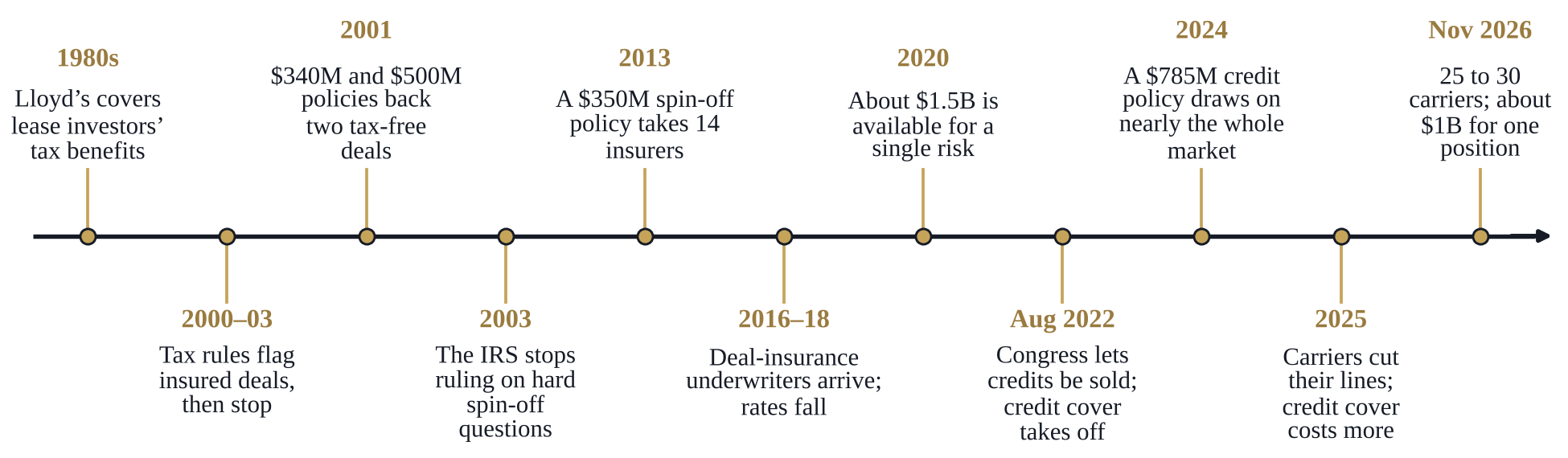
Exhibit 1. Forty years of tax insurance: the milestones. Sources: notes 16–25 and 41. The 1980s origin rests on trade press and broker recollection; nodes are not to scale.
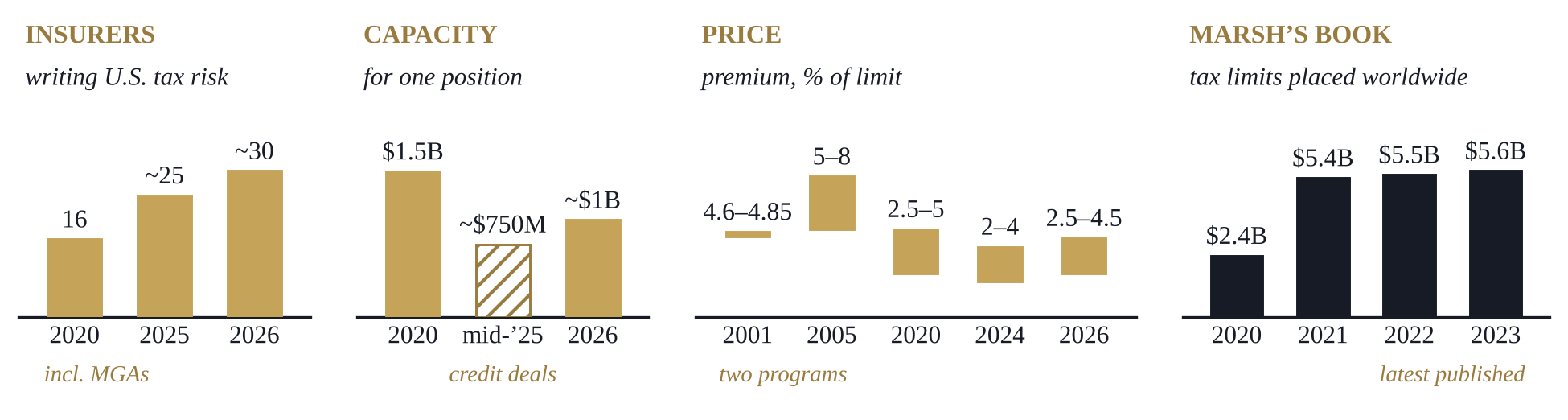
Exhibit 2. Four measures of the market. Sources: note 22. Insurers: the 2020 count includes managing general agents (MGAs); 2025 and 2026 are Lockton’s counts. Capacity: mid-2025 is one account of credit deals. Price: U.S. risks; 2001 is two programs, with expenses. Marsh’s latest published year is 2023.
The Inflation Reduction Act did the rest. Once tax credits could be sold for cash, buyers wanted cover, and credit insurance became the market’s largest line. Some $42 billion of credits changed hands in 2025, and one broker alone wrote $9 billion to $10 billion of credit limits. Then the market hardened. Capacity for credit risks had roughly halved by mid-2025, and a credit policy now typically costs 4% to 6%, by one account, up from 2% to 4% in 2024. Carriers have since come back. Today 25 to 30 A-rated carriers write U.S. tax risk, and roughly $1 billion is available for one position.
03 One premium takes one named risk off the table
Tax insurance does a job nothing else in a deal does. A ruling would settle the question, but the IRS will not rule on the hardest ones and takes months on the rest. (Deals close in weeks. Rulings arrive in seasons.) An indemnity moves the risk only as far as the seller’s balance sheet, and a fund plans not to have one. An escrow secures the risk by freezing the cash. A policy settles who bears the loss, puts rated balance sheets behind the answer, and lets the money go. Marsh says buyers use it most; sellers get what it calls a clean exit.
A tax policy covers one identified position: this spin-off was tax-free, say, or this credit was earned. If a tax authority disagrees and wins, the insurer pays. A buyer’s policy lets the seller walk away; a seller’s policy backs the indemnity the seller has given. Exhibit 3 sets out the usual terms. Exhibit 4 shows the steps; watch where payment falls, at the end of a contest the insured must run.
Placement usually takes two to four weeks. “Get the insurance done before you report that position in a tax filing,” says Marsh’s Mark McTigue. Once the IRS finds the issue, cover is hard to get; Alliant’s James Chenoweth puts the price at three to four times as much. (Fire insurance is also cheaper before the fire.)
| Term | Market practice |
|---|---|
| What it pays | Tax, interest, penalties (not fraud), contest costs, and a gross-up, up to the limit. The retention is often just the contest costs; in 2020 Marsh’s authors put it at $250,000 to $500,000 |
| Limit and term | $5 million to about $1 billion, sized to the worst case; seven years is standard and ten is available |
| Price | 2.5% to 4.5% of the limit for U.S. risks, paid once (1% to 2% in the United Kingdom; 3% to 6% for energy credits, though sources differ), plus an underwriting fee of $40,000 to $100,000 and premium taxes (section 07) |
| What insurers need | A written analysis at “more likely than not” or better; stronger comfort buys a lower rate. They decline abusive shelters, listed transactions, most reportable transactions (large losses are an exception), and bets on not being audited |
| Exclusions | Changes in law, inconsistent filings, misstatements to insurers, unapproved settlements, fraud |
Exhibit 3. What a tax policy looks like in late 2026. Sources: Marsh; Gallagher; Lockton; Vanbridge; PV Tech (notes 24 and 27).
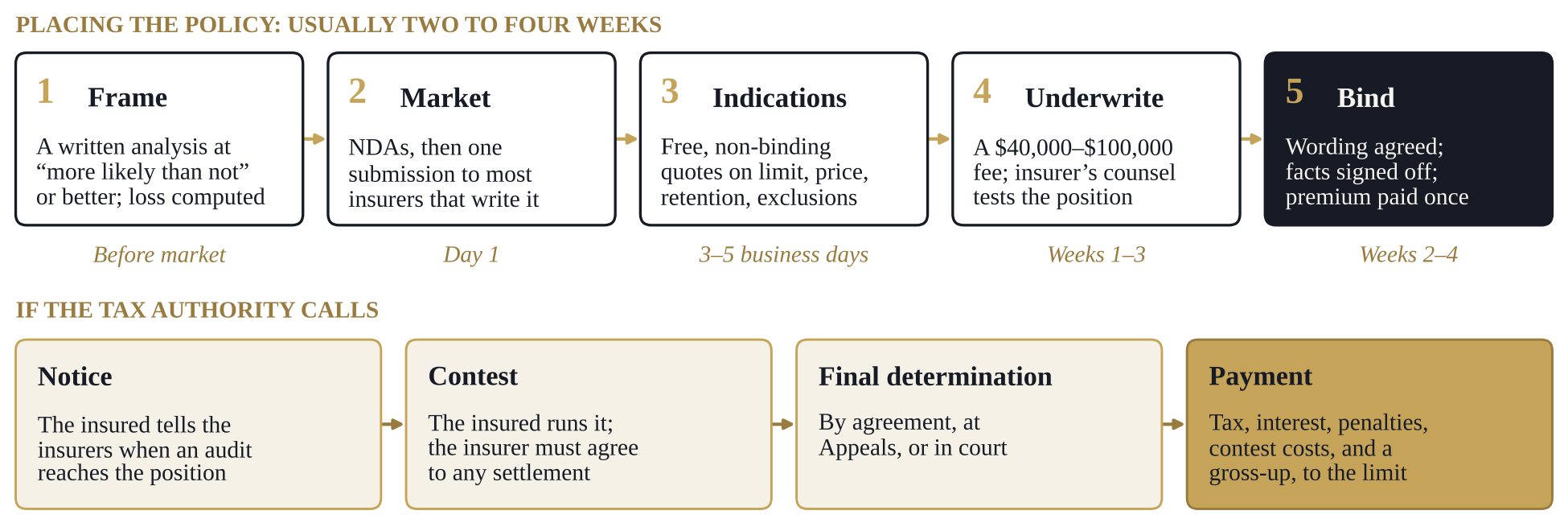
Exhibit 4. From a diligence finding to a bound policy, and what happens if the audit comes. Sources: Marsh; Gallagher; Vanbridge (notes 27 and 28).
Representations and warranties (R&W) insurance pays when a seller’s statements about the company, tax included, prove wrong. By one broker’s estimate, three of four private equity deals use it. Its firmest exclusion is anything the buyer already knew. R&W is for surprises. Tax insurance is for the known problem.
The two are family. Tax insurance is the older cousin (“Tax insurance predated R&W,” says Aon’s Gary Blitz, who was counsel on the first U.S. R&W policy), but it grew up on the R&W boom. By 2019 about half of the two dozen carriers writing R&W also wrote tax. Today the same brokers place both, at similar prices.
R&W has already shown what a policy does to an escrow. In SRS Acquiom’s study, the median indemnity escrow was 10% of the price where no R&W policy was identified and 0.35% where one was: $50 million against $1.75 million on a $500 million sale. The tax indemnity is what R&W left behind. A tax policy finishes the job.
04 Poor guarantors make natural policyholders
A fund is a poor indemnitor by design. Its plan is to hand cash to its investors and then cease to exist, which is not what a buyer looks for in a guarantor. So a buyer asks a fund for an escrow where it would take a corporation’s promise. Dissolving does not end the exposure, either. Delaware requires a dissolved partnership to provide for contingent claims, and under the partnership audit rules an adjustment follows the former partners.
About $1.2 trillion sits in funds more than ten years old, and one fund in a Hilco case study had sold every asset and was still open, held there by liabilities that included tax indemnities. Real estate funds have a live example. In 2025 Treasury proposed to repeal the rule that looks through certain domestic corporations to their owners in testing whether a REIT is “domestically controlled.” The repeal is still only proposed, and authors in The Tax Adviser say the wait could bring more negotiated FIRPTA escrows (cash held back against a foreign seller’s tax). Each question will be answered years after the cash should have gone out. For a fund at the end of its life, a policy can be the difference between a final distribution and a reserve. Exhibit 5 lists where funds use the product.
| Where | What is insured | Code sections |
|---|---|---|
| Exit or acquisition | A known issue that R&W insurance excludes: a large loss, S corporation status behind a basis step-up, an earlier spin-off, net operating losses | §§165(g), 1361–1362, 338(h)(10), 355, 368, 382 |
| Fund wind-down | Tax indemnities and audit exposure that would otherwise keep a reserve, and the fund, alive | §6241(7); 6 Del. C. §17-804(b) |
| Secondaries and continuation funds | Pre-closing audit years; withholding on the transfer | §§6225–6226, 1446(f) |
| Private credit | Whether lending makes an offshore fund a U.S. business; treaty and withholding positions | §§864(b), 881, 882, 1441–1442, 1446(a) |
| Real estate | REIT status; “domestically controlled” status under FIRPTA | §§856–857, 897(h)(4) |
| Energy and infrastructure | Credit qualification, basis, recapture, and transfers | §§45, 48, 45Y, 48E, 50(a), 6418 |
Exhibit 5. Where funds can use tax insurance. Source: La Presa summary of broker and underwriter publications and the Code. Public examples are thin for the secondaries and private credit rows.
05 An escrow costs a point of IRR; a policy, a seventh
Take a buyout fund. In January 2022 Harbor Fund IV, L.P., managed by Harbor Partners, paid $200 million of equity for the stock of Northline Parent, Inc., the holding corporation of Northline Services. In January 2027 it is about to sell Northline Parent at a price that sends $500 million to the fund: 2.5 times its money in five years, a 20.1% IRR. Then the buyer’s diligence finds a $50 million tax question.
It sits on a return that has not been filed yet. In 2026 Northline closed its failed European subsidiary, and it will deduct the $184 million invested in it, mostly under earlier owners, as worthless stock on Northline Parent’s return; the loss shelters most of the gain on the sale of its fleet division that year. The Code allows that loss in the year the stock becomes worthless, and the IRS can argue that the subsidiary still had value, that the year was wrong, or that the loss is capital. Harbor’s advisers rate the position a “should,” a notch above the “more likely than not” that insurers ask for. If it fails, Northline owes about $50 million of tax and interest (Exhibit 6), and the buyer will own Northline. The market has insured this question before. CSRA’s 2017 annual report describes a policy, obtained under its merger agreement with SRA, on a disputed $136.7 million worthless-stock deduction.
The buyer could take the $50 million off the price. More likely it asks the fund to leave the money in escrow until the IRS can no longer assess tax for 2026, which is three years after the return is filed in October 2027, plus a tail (we use 90 days). The third route is a policy, paid for by the fund and in place before the return is filed, that names the buyer and Northline Parent as insureds. Its limit is larger than the escrow because it also covers a penalty, three more years of interest, the fight, and tax on the payout (the gross-up, at 21%). Exhibit 7 shows the three routes.
| Input | Assumption |
|---|---|
| The tax question | A $184 million worthless-stock deduction on Northline Parent’s 2026 return: $38.6 million of federal tax at 21% (state income taxes are ignored) |
| Escrow | The tax plus interest at 7% a year, compounded daily, from April 2027: about $50 million by January 2031, 90 days after the IRS’s time runs out. Held four years, earning 4% |
| Policy | $90 million limit: the tax, interest to the end of 2033 ($23.2 million), a 20% penalty ($7.7 million), $1.5 million of contest costs, and a gross-up at 21%. Premium of 3% of the limit; $3.0 million all-in; seven years |
Exhibit 6. The tax question, the escrow, and the policy (hypothetical). Source: La Presa model (note 35). Both assume the full 2026 tax; a deduction allowed in another year would cut the loss. The limit holds interest at 7%; the 9% large-corporate rate and interest on the penalty could add $5 million to $12 million, or a basis point or two of cost.
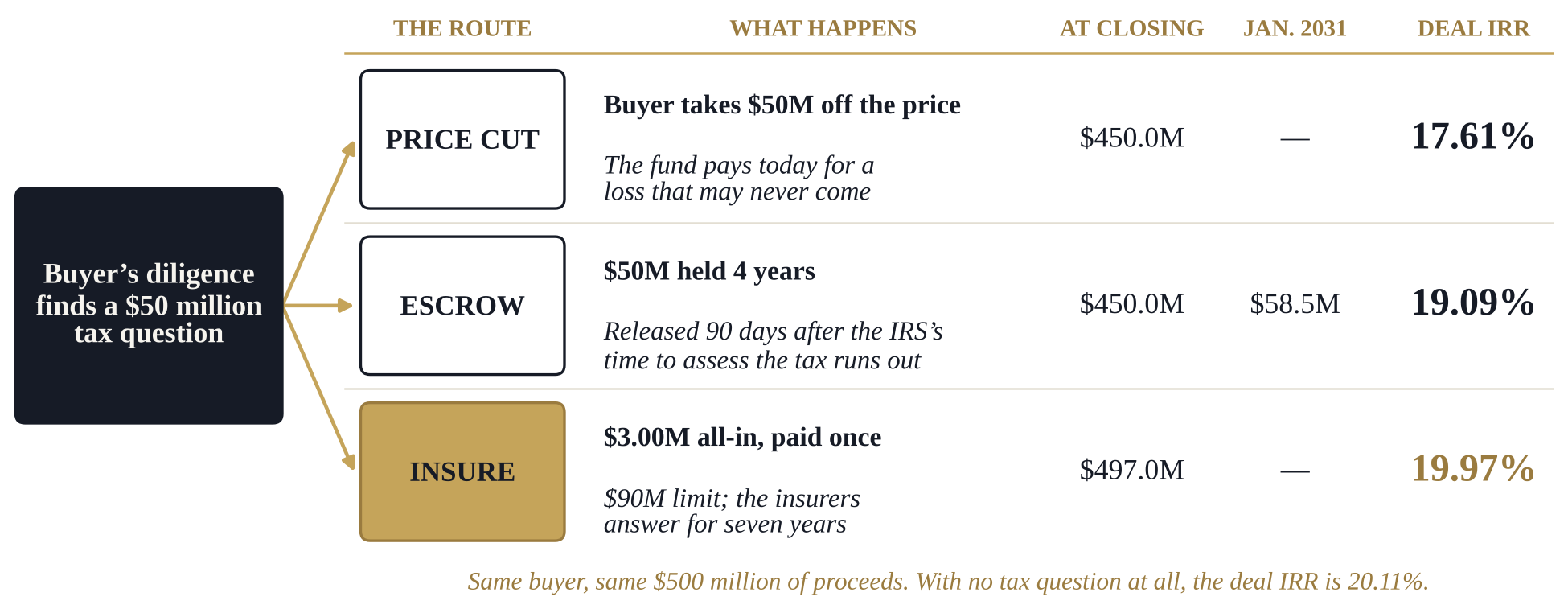
Exhibit 7. One tax question, three ways to carry it (illustrative). Source: La Presa model; inputs in Exhibit 6.
Read the last column against the 20.11% a clean deal would have earned. The policy costs the deal 14 basis points of IRR. The price cut costs 250, for a loss that will probably never happen. The escrow costs 102, even though every dollar comes back with interest. (Its money multiple is higher than the policy’s, 2.54x against 2.49x, which is why a multiple is the wrong lens for an escrow.) These are deal figures. In a fund of ten equal deals, one such escrow costs about 10 basis points of gross fund IRR, and a fund has more than one exit.
The arithmetic is short. Escrowed cash earns a money-market yield, about 4% today, while we assume Harbor’s investors discount at 12%. (The escrow may be the one holding in the fund that everyone agrees will earn 4%.) At 4%, the $50 million grows to $58.5 million by the time it is released. Discounted at 12%, that is worth $37.2 million at closing, so the wait costs $12.8 million. The policy costs $3.0 million: a $2.7 million premium plus the insurer’s underwriting fee, the state tax on the premium (section 07), and counsel. The policy wins whenever investors’ cost of capital exceeds the escrow’s yield by more than 1.6 points; here the break-even is 5.6%, and we know of no buyout fund whose investors would take that. Double the premium rate and the policy still costs only 28 basis points. Exhibit 8 runs the same arithmetic for other sizes and terms. (The only published version we found is Aon’s from 2014: 77 basis points, for a general escrow. Aon in 2015 and Howden in 2014 put dollars on the point.)
Now wait four years, as the fund must. In the escrow’s best case the IRS never calls, and in January 2031 the fund collects $58.5 million it could not use in the meantime. Nobody should count on that. Northline will probably have to flag a loss this size to the IRS on the return itself (section 07), and a release date tied to the statute is a floor. If the IRS opens an exam or asks for more time, the cash stays. (An escrow’s release date is like a flight’s departure time: printed, and subject to events. When CSRA reported in 2017, the IRS was still disputing SRA’s deduction, taken on its 2011 return.) If Northline is the fund’s last asset, Harbor Fund IV must stay open four more years to collect; at an assumed $400,000 a year that costs $1.6 million, more than half the policy’s price. And the position can lose. Then the escrow is gone, and the policy pays.
| Escrow as a share of proceeds | 2 years | 3 years | 4 years | 6 years | Policy instead |
|---|---|---|---|---|---|
| 5% ($25 million) | 30 | 42 | 52 | 69 | 8 |
| 10% ($50 million) | 59 | 82 | 102 | 135 | 14 |
| 15% ($75 million) | 87 | 122 | 151 | 199 | 21 |
| 20% ($100 million) | 115 | 160 | 198 | 261 | 28 |
Exhibit 8. Basis points of deal IRR lost to an escrow, by size and years held, and to the policy that replaces it (illustrative). Source: La Presa model (Exhibit 6). Costs are measured against the clean deal; the policy limit is 1.8 times the escrow.
Go seat by seat and the policy is hard to argue with. The fund collects 2.49 times its money at closing, against 2.25. Harbor Partners can compute carry and wind up. Management sellers are paid in full on day one. The buyer gives something up. Escrowed cash answers from the first dollar, while a policy has a retention (often a few hundred thousand dollars of contest costs), exclusions, and a say for the insurer in any settlement, and it pays when the contest ends, which can be years later (section 08). In exchange the buyer gets seven years of cover instead of four, a limit nearly twice as large, A-rated insurers, and no dissolved fund to chase.
Divide the policy’s all-in cost, as a percentage of the escrow it replaces, by the years the escrow would run. If your investors’ cost of capital exceeds the escrow’s yield by more than that number, insure. Here the policy costs 6% of the escrow; over four years that is 1.5 points a year (the exact break-even is 1.6). The rule cuts both ways. At six years the bar falls to 1.0 (1.1 exact). And a short wait favors the escrow: one due for release within about ten months costs less than the policy at our assumed 12%, or within about five months by deal IRR, the measure in Exhibit 8.
06 Big risks need a tower, and a tower needs a broker
No insurer wants a whole city on its books. In 2024 London carriers often put out $50 million or more on one tax risk, and managing general agents (firms that underwrite on insurers’ behalf) usually write €5 million to €30 million. Insurers have to share a limit in the hundreds of millions, and they do it by building a tower (Exhibit 9, which reads from the bottom up). A lead insurer underwrites the position and negotiates the wording, and it takes the first dollar of loss at the highest rate. It earns that rate because it pays first, and a loss that settles for part of the tax may never reach the layers above. Excess insurers stack above, each layer attaching where the last one ends, at falling rates, so the blended price drops as the program grows.
A tower does not assemble itself. Someone has to frame the risk so that 16 underwriters read it the same way, pick a lead, fill each layer, keep the layers’ wording aligned, and, years later, stand beside the insured when a claim tests it. That someone is the broker. Sixteen insurers on one program is a committee; the broker’s job is to make it behave like a counterparty.
On one side are the underwriters: managing general agents such as Ambridge, Euclid Transactional, and Ryan Transactional Risk, and carriers such as AIG, Chubb, Zurich, Liberty Mutual, and Berkshire Hathaway Specialty, all of which have written tax risk. On the other side are the brokers, among them Marsh, Aon, Lockton, Howden, Gallagher, Brown & Brown, and Alliant, and specialists such as Vanbridge, Baldwin’s CAC, and Atlantic Global Risk, which Howden agreed in January to buy. When Atlantic placed a $785 million carbon-capture credit policy in 2024, it worked with what it called “nearly all of the tax insurance underwriters in the North American market.” At that size the market is one room, and a broker’s standing in it matters.
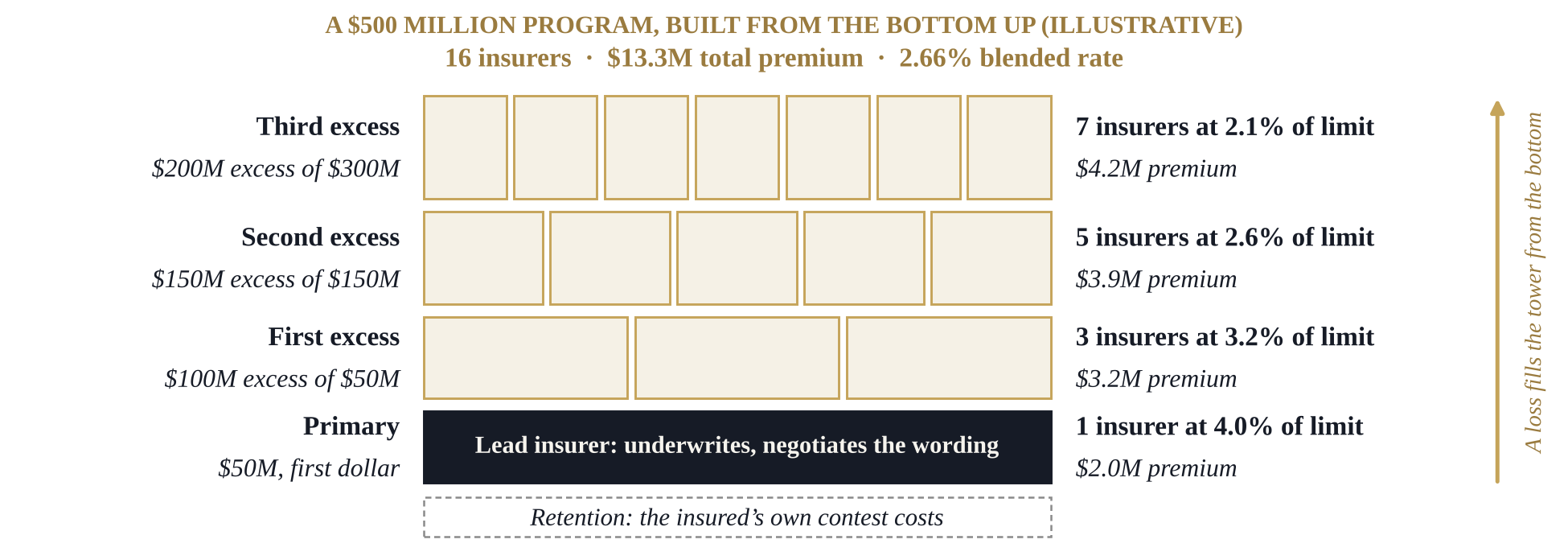
Exhibit 9. How a $500 million tax risk is syndicated (illustrative). Source: La Presa illustration. Sizes, counts, and rates are assumptions; the structure follows broker descriptions (note 39). There is precedent: in 2001, Georgia-Pacific lined up its $500 million from 14 insurers (note 17).
Whom to call first? Ask any broker to show you a program of your size that it has built. (Brokers enjoy the question in proportion to their answer.) On the public record, our first call for a large or unusual tax risk would be Marsh (now trading as Marsh Risk). The reasons are specific to tax, and the first is that Marsh shows its work.
$5.6 billion: the tax limits Marsh placed worldwide in 2023, the latest year it has published, on 235 policies. In 2020 it placed $2.4 billion on 113. Marsh USA alone, it said in 2024, had bound more than $11 billion since the start of 2020.
$1 billion: the largest U.S. tax limits Marsh had reported placing by 2024. In London it reported several programs above $1 billion, drawing on capital from outside the specialist tax market.
82%: the growth in 2025 in the number of tax policies Marsh placed in North America. In Europe the count rose more than 50% and limits more than doubled.
Nine: Marsh’s people in the United States and Canada who do nothing but tax insurance. In 2024 Marsh called its European tax broking team the largest there.
Those numbers are Marsh’s own, and that is the point. Marsh publishes its limits and policy counts by year and a regular map of rates, so a client can check a quote against the market. Its head for continental Europe says his team takes a submission to nearly every insurer in the market, and Marsh says its U.S. team led the market for two years running, by its own count in 2024, in tax submissions sent to underwriters. Its fee for the placement, Marsh says, covers core claims handling. (We are tax advisers, not brokers. We place no insurance, and this view rests on the public record alone.)
Marsh is not the only good answer. Aon, which calls itself the leading global tax insurance broker, publishes the largest cumulative total we found: more than $65 billion of tax limits on more than 900 policies since 2017, many above $500 million. Its claims study, the best public data on the subject we have seen, reports more than $350 million recovered for clients in North America, and a first notice of claim that arrives, on average, 26 months after the policy starts. Lockton’s survey is the best we have seen on credit insurance. Howden reports £8 billion of tax and contingent cover placed in 2025 by a division of 40 specialists. We found no league table of tax brokers, and we have not built one. Whichever firm you call, the broker is normally paid a commission out of the premium, so ask for the number in writing. Marsh’s U.S. compensation guide commits it to answer.
07 Even the insurance gets taxed
For the tax department: the law tolerates tax insurance and has said little about it, and what it has said mostly favors the IRS. The uninvited party, it turns out, has views on the insurance bought against it.
- Buying a policy does not make a deal reportable. Under Treas. Reg. §1.6011-4(b)(4), “contractual protection” means refundable or contingent fees paid to whoever gave the tax advice. Insurance left the definition in 2003, and Treasury said in 2006 that a transaction is not reportable “simply because there is tax result protection for the transaction.” If a deal is reportable for another reason, the policy goes on Form 8886 and the insurer may be a material advisor. Northline’s loss probably is such a case. A corporate loss of $10 million or more in a year is a reportable “loss transaction” unless an exception applies, and none names worthless stock. It is the one kind McTigue says his team insures.
- The premium buys certainty about everything except itself. No statute or regulation addresses its treatment, and no court has. A premium paid to close a deal looks like a cost of the deal: basis for a buyer, a smaller amount realized for a seller. Two 2020 Chief Counsel memoranda denied a deduction for the premium to partnerships that had claimed charitable deductions, on reasoning broader than their facts. Assume no current deduction.
- Proceeds may be taxable, hence the gross-up. Clark excluded what a taxpayer recovered from the adviser whose error had cost him extra tax, and the Tax Court read it broadly in Cosentino. The IRS reads it to reach only tax the error added; the Eleventh Circuit, asked in 2020 how far Clark goes, answered, “These are very difficult questions.” A policy pays tax that was owed all along, so on the IRS’s reading the payment is income. (On that reading the IRS taxes the check that pays its own bill.) A buyer’s policy has a better argument (a payment for the target’s pre-closing tax resembles a seller’s indemnity, which adjusts the price), though no authority applies it to an insurer. Size the limit for the worst case. At 21%, a $12 million loss needs $15.2 million to leave a corporation whole; at an individual’s 37%, about $19 million.
- There is a tax on insuring against tax. Section 4371 taxes casualty premiums paid to foreign insurers at 4 cents on the dollar unless an exemption applies. Lloyd’s underwriters have a closing agreement under the U.K. treaty, so premiums paid to them are generally exempt. State tax is separate. On surplus lines paper (an insurer not licensed in the state), the insured’s home state taxes the premium at 3.6% in New York, 3% in California, and 4.85% in Texas.
- Underwriting can cost privilege. An opinion sent to a broker and insurers has probably left the privileged circle (all of them may keep the secret; privilege asks only whether you told them), and the statutory privilege for a CPA’s advice is narrower still. Work product survives disclosure to a non-adversary (Deloitte), but a deal-stage tax analysis may not be work product at all (Textron), and using it later with the IRS can waive what remains (Sanmina, as it happens a worthless-stock case). In Schaeffler the Second Circuit found a common legal interest with lenders who had in effect insured the taxpayer; other circuits are narrower. Send a purpose-written risk memo under a confidentiality agreement; leave the correspondence at home.
- The reserve stays on the books. An uncertain position is still measured on its merits under ASC 740. On KPMG’s reading, a policy bought for an existing risk can add a benefit no larger than the premium paid, so the effective tax rate is not repaired.
08 Where the policy stops
- It needs a real position. Insurers want a reasoned analysis and test it with their own counsel. The mainstream market stays away from shelters. As William Kellogg, then of Berkshire Hathaway Specialty Insurance, told Tax Notes, “The insurers are not playing the audit lottery.”
- It pays last. The examiner, Appeals, and sometimes a judge speak first. The insured must contest the tax to a final determination, and the insurer must approve any settlement. That can take years: after the exam, Appeals alone averaged 589 days on a large corporate case in fiscal 2025 (through April), and 942 on the largest. Enterprise Financial recorded a $24.1 million credit recapture in the third quarter of 2025; a year later the $32.1 million it expects from insurers was still a pending claim. Plan liquidity for the gap.
- It has minimums, and capacity moves. Underwriting fees and minimum premiums make a policy poor value for an exposure of a few million dollars; there a short escrow can be cheaper. Capacity for credit risks fell by about half by mid-2025, by one account, and has partly recovered. Line up large programs early.
- It is not a license, and it can be turned against its buyer. Investors in syndicated conservation easements, which the IRS listed in 2016, have filed at least 20 suits against their tax insurers over consent to settle and what counts as a loss, with about $1 billion of limits at stake by their lawyers’ estimate. In easement audits the IRS has also argued, by Hale Sheppard’s account, that buying a policy shows a lack of good faith.
- A written analysis that the insurer’s counsel can adopt, finished before the broker goes to market; a policy in force before the position appears on a filed return; and a covenant fixing who files that return, when, and in what form (with Form 8886 if the loss is reportable).
- A limit sized to tax (federal and state), interest, penalties, contest costs, and gross-up, and a term that outlasts the statute, counted from the day the return is filed.
- The right insureds: buyer, fund, successors, and, for a pass-through, whoever would bear the tax (the fund on an imputed underpayment, former partners after a push-out). With them, a waiver of the insurers’ subrogation rights against the fund, and a purchase agreement that makes the policy the buyer’s only recourse on the insured position. Without the waiver, an insurer that pays could press any claim the buyer kept against the fund, which would then have to hold a reserve against it.
- Consent-to-settle terms negotiated up front, with an agreed path if the insured wants to settle at Appeals.
- A-rated carriers on every layer, the broker’s compensation in writing, and a line in the purchase agreement saying who pays the premium and the taxes on it.
- The Third Circuit’s decision in YA Global, argued on September 30, which matters to every credit fund that lends from offshore.
- Final action on the domestically controlled REIT proposal; foreign-entity guidance for energy credits, a risk insurers mostly will not write yet; and the first policy written against an imputed underpayment under the partnership audit rules, the subject of our alert last week. (We found no public example.)
Our take
The fake Paris was never bombed, and by the early 1920s it was gone. Its lighting engineer had more to do. On July 4, 1925, Fernand Jacopozzi switched on 250,000 bulbs that spelled CITROËN down the Eiffel Tower. The man who lit the decoy ended up lighting the city. We like that as a description of good risk transfer. It lets the lights go back on.
Tax insurance is a narrow tool. It will not rescue a weak position, it pays slowly, and its own tax treatment is unsettled in ways advisers should say out loud. But for a known, well-reasoned risk in a fund that must return cash and close, it is usually the cheapest tool on the table, and often the only one that lets everybody go home.
The market asks what the policy costs. That is the easy question, because the premium is printed on the quote. An escrow comes with no quote, because its price is paid in time, by a vehicle whose scarcest asset is time. Price the escrow first. Then call the broker.
Notes and further reading
“§” refers to a section of the Internal Revenue Code of 1986, as amended (the “Code”), and “Treas. Reg.” to the Treasury regulations, each as in effect on November 23, 2026. We opened web sources on November 22, 2026, and say so where we cite one source through another.
- KPMG, “More leaders are using DPI—not IRR—to build resilience and generate cash without waiting for full exits” (July 2026), p. 2. Bain & Company, Global Private Equity Report 2026 (Feb. 2026) (distributions about 14% of net asset value in 2025), and its midyear release (June 8, 2026).
- SRS Acquiom, 2025 M&A Deal Terms Study, p. 58, and its two-page quick reference (the latest edition we could open; the 2026 edition is gated). Gary P. Blitz and Daniel Schoenberg (Aon), “Private REITs: Facilitating a Cleaner Exit with Tax Insurance” (May 7, 2015) (up to 10% of proceeds).
- Aon, “Tax Insurance” (more than $65 billion of limits on more than 900 policies since 2017). Capacity: note 25.
- Myron S. Scholes et al., Taxes and Business Strategy, 5th ed., ch. 1, p. 20.
- C. G. Sweeting, “The Five O’Clock Taube: First Air Raids on Paris,” Aviation History (Nov. 2018), paras. 3–5. Accounts differ on the number of bombs and on casualties.
- Musée de l’Armée and Archives départementales du Val-d’Oise, “Documents croisés: le Camp retranché de Paris,” pp. 5–9, reproducing the air-defense command’s 1918 album. The best account in English, and a pleasure to read, is Gavin Mortimer, “Creating fake Paris,” BBC History Revealed (Apr. 2022). French sources make the project the army’s, with Jacopozzi’s firm as lighting contractor.
- Ian Sumner, “Kings of the Air: ‘War, German style’ 1” (June 3, 2014), paras. 3–5; Guy François (note 8) counts 267 dead. City of Paris, “Paris 14-18,” chapter “Big Bertha” (the long-range guns, March 23 to August 9, 1918).
- Guy François, Forum Pages 14-18 (posts of Nov. 18–22, 2011, from French military records); Theatrum Belli, “In memoriam: Camille Mortenol” (10,000 men); Marcel Poëte (1926), on the City of Paris’s “Paris 14-18” exhibition site.
- Guy François (note 8) (work from March to November 1918). French Wikipedia, “Réplique de Paris,” relaying Xavier Boissel, Paris est un leurre (2012), pp. 14–16 and 64 (the first replicas finished in September, after the last raid; lights running up to 2,000 meters). Mortimer dates that raid September 16; Poëte, September 15. Station Haxo places the site near today’s Roissy airport.
- The Illustrated London News, Nov. 6, 1920, p. 729 (headline as given by Mortimer (note 6); page number from the Mary Evans Picture Library).
- Darren Orf, “In WWI, France started to build a fake Paris to confuse German bombers,” History Facts (Sept. 10, 2026). We owe it the idea and thank it for the tip. On details we follow Sweeting, Mortimer, and the French sources.
- Luisa Piccinno and Antonio Iodice, “Managing Shipping Risk: General Average and Marine Insurance in Early Modern Genoa,” in Maritime Risk Management (Duncker & Humblot, 2021), p. 84 (a contract of March 18, 1343). Lloyd’s tells its own history well: “Coffee and commerce” (1688 and 1773), “Lloyd’s and the San Francisco earthquake,” and “Going out on a limb” (Grable’s legs, $1,000,000; Turpin’s eyes, a $25,000 policy, its seriousness “open to conjecture”). Press accounts put Grable’s policy lower.
- Bryce R. Pressentin et al. (Euclid Transactional), “S Corp M&A: Three Options for Addressing Income Tax Concerns,” Bloomberg Tax (Mar. 14, 2022) (rulings under §1362(f) took six to nine months in practice).
- City of Paris, “Paris 14-18,” chapter “Big Bertha” (note 7) and item 4. The curators date the brochure before the long-range guns opened fire in March 1918.
- Aon, 2026 Transaction Solutions Global Claims Study, ch. 1.4 (policies placed 2014–2025: 7.3% drew a notice, 4.1% a claim, and 1.6% a payment; 2.5% had claims open; first notice came 26 months after inception on average). Aon calls the data nascent and expects the paid share to climb.
- Taryana Odayar, “Trio of Disputes Set to Shape Burgeoning Tax Equity Insurance Biz,” Power Finance & Risk (Nov. 30, 2018), p. 1. Gregory DL Morris, “Booming Tax Insurance Demand Outpaces Underwriting Talent,” Risk & Insurance (Apr. 23, 2019) (Aon’s Gary Blitz, on the 1980s). Scott Brady, Mark McTigue, Antony Joyce, and Alisha Soares (Marsh), “Demystifying Tax Insurance,” NYSSCPA Tax Stringer (Nov. 1, 2020), which dates the product to the 1990s. We found no primary Lloyd’s record.
- Maxtor Corp., Form S-3 (May 29, 2001) (premiums of about $15.7 million). Plum Creek Timber Co., Form S-4/A (July 13, 2001), pp. 5–8 and 65–67 (the 14 insurers and their shares), and Exhibit 10.3; Georgia-Pacific was to pay any premium above the cap, which the filing calls de minimis. Gartner, Inc., Form 10-Q (Feb. 13, 2002) (announced Jan. 10, 2002). The percentages are our arithmetic.
- T.D. 8877, 65 Fed. Reg. 11205, 11207–08 (Mar. 2, 2000); T.D. 9017, 67 Fed. Reg. 64799, 64802 (Oct. 22, 2002) (for transactions entered into on or after Jan. 1, 2003); T.D. 9046, 68 Fed. Reg. 10161, 10162 (Mar. 4, 2003) (effective Feb. 28, 2003; taxpayers could apply it from Jan. 1). Hale E. Sheppard, “Three New IRS Challenges to Tax Insurance in Conservation Easement Disputes,” Journal of Taxation (June 2021), pp. 22–23, recounts the insurers’ comment letters.
- Rev. Proc. 2003-48 (requests received after Aug. 8, 2003), later superseded (Rev. Proc. 2017-52). Aon’s case study of a 2013 placement gives the ruling policy as the client’s reason for buying.
- Gary Blitz (Aon), “Peace of Mind In Handling a Target’s Taxes,” Mergers & Acquisitions (Dec. 2, 2005). Aon case study (note 19) ($13 million premium). Risk & Insurance (note 16) (14 carriers).
- Risk & Insurance (note 16). Insurance Journal (July 27, 2016) (Euclid, a managing general agent) and (Sept. 10, 2018) (Liberty, combining two existing teams). Rates in 2020: 2% to 4% (Baker McKenzie, note 50, p. 2); 2.5% to 5%, with 16 insurers writing U.S. risks (Marsh’s authors, note 16).
- Insurers: Marsh’s authors (note 16) (16 insurers and managing general agents, which they call managing general underwriters, in late 2020); Lockton (note 25). Capacity: Marsh’s authors (about $1.5 billion in 2020); notes 24 and 25. Price: notes 17 and 20; Marsh’s authors (2.5% to 5% in 2020); Marsh’s maps (note 27) (2% to 4% in early 2024; 2.5% to 4.5% in early 2026). Marsh: Global Tax Bulletin 2024 (note 42), p. 2 ($2,372 million on 113 policies in 2020; $5,372 million on 173 in 2021; $5,497 million on 160 in 2022; $5,641 million on 235 in 2023). For 2018, Risk & Insurance (note 16) reports more than $1 billion of limits placed by Marsh and more than $6 billion bound by Aon.
- Pub. L. 117-169 (Aug. 16, 2022); §6418. Latitude Media (July 1, 2026) (Crux data). David Burton, Norton Rose Fulbright Tax Equity News (Apr. 27, 2026). Aon (note 15) (credit policies about twice the volume of its other tax policies).
- Pub. L. 119-21 (July 4, 2025), §§70512–70513. Bryen Alperin (Foss & Company), “Tax insurance after OBBB,” PV Tech (Nov. 2, 2026) (a credit policy typically costs 4% to 6%, up from 2% to 4% in 2024, a rise he puts down mostly to supply; per-policy capacity from about $1.5 billion to $700–800 million by mid-2025). Others put credit rates lower: 3% to 5% (Norton Rose Fulbright, note 23); 1.6% to 3.5% and rising (Gallagher, note 27).
- Counts differ: about 30 A-rated carriers (Lockton, 2025–2026 Renewable Energy Tax Credit Insurance Survey (Nov. 2026), p. 2), up from about 25 in its 2024–2025 survey, p. 2; more than 25 (Gallagher, Tax Insurance (2026), p. 3); more than 20 (Vanbridge, Tax Liability Insurance FAQs (Dec. 2025), p. 2). Capacity: Vanbridge, p. 2; Daniel Berger (Lockton), Currents podcast, ep. 327 (Dec. 11, 2025) (about $1 billion after carriers cut their maximum lines). We found no market-wide total of limits or premium.
- Marsh, “Using tax liability insurance to maximize value in an M&A transaction and beyond” (July 17, 2023) (known issues that R&W policies leave out; buyers the most frequent users; the clean exit). Gallagher, Representations and Warranties Insurance (2026) (about 75% of private equity deals, an estimate; exclusions for what the buyer knew and for net operating losses; a rate near 3% of the limit). Risk & Insurance (note 16) (Blitz; about half of two dozen R&W carriers wrote tax in 2019). SRS Acquiom, quick reference (note 2) (median escrows in 2024 deals; the dollar figures are our arithmetic). Rulings: notes 13, 16 (Blitz, on areas where the authorities will not rule), and 19.
- Marsh, “Tax Insurance” (cover and term); Marsh, Transactional risk insurance map, first quarter of 2026, p. 3 (rates; 2% to 4% for U.S. risks two years earlier); Gallagher, Global M&A Insurance: 2025 Review and 2026 Outlook, p. 13 (fees); Lockton (note 25), pp. 7, 14 (retentions; term); Marsh’s authors (note 16) (retentions in 2020; exclusions); Marsh, Tax insurance (U.S. brochure, 2022), p. 4 (price); Vanbridge (note 25) (what insurers decline); note 45 (large losses).
- Marsh, Tax Insurance (Asia brochure, 2021), p. 5 (three to four weeks); Gallagher, Tax Insurance (note 25), p. 3 (the whole process in 10 to 15 business days); Vanbridge, “Tax Insurance: A Growing Market” (Dec. 2025) (as little as two weeks).
- Marsh, Risk in Context podcast, ep. 123 (Jan. 2026), transcript, p. 7. James Chenoweth (Alliant), “The Tool of Tax Insurance Can Absorb the Risks of Uncertainty,” Bloomberg Tax (Feb. 2, 2023) (three to four times).
- 6 Del. C. §17-804(b); §6241(7); Treas. Reg. §301.6241-3.
- Michelle Celarier, “More Than $1 Trillion Is Stuck in ‘Zombie’ Private Equity Funds,” Institutional Investor (July 28, 2026) (a Treo Asset Management estimate). Hilco Global, “Liability Resolution for Fund Closure” (resolved by a sale of the liabilities, not by insurance).
- REG-109742-25, 90 Fed. Reg. 48422 (Oct. 21, 2025). Mike Greenberg, J. David White, and Andy He, “Recent regulations affect US real estate investments,” The Tax Adviser (July 31, 2026), the latest confirmation we found that the repeal remains proposed.
- §165(g)(1) and (3) (an ordinary loss where a domestic corporation directly owns stock meeting the 80% tests of §1504(a)(2) and more than 90% of the subsidiary’s gross receipts came from operations); Treas. Reg. §1.165-5(d)(1) (the subsidiary may be foreign); Rev. Rul. 2003-125 (no loss if the subsidiary’s assets, goodwill included, exceed its liabilities); §11(b) (21%). We assume Harbor bought stock in 2022 with no step-up election, so the subsidiary’s basis carried over.
- CSRA Inc., Form 10-K (May 25, 2017), note 15, “Tax Examination Status.” The deduction was claimed on SRA’s 2011 return, and the IRS was still disputing it.
- §6501(a), (c)(4) (extension by agreement), (c)(8) (the period stays open until three years after required foreign information returns are filed), and (e)(1)(A) (six years, but only for omitted income). Interest: §§6601(a), 6621(a)(2), and 6622(a); Rev. Rul. 2026-15 (7% for the fourth quarter of 2026, held flat in our example; 9% for large corporate underpayments under §6621(c), which we assume would start in August 2030); §6601(e)(2)(B) (interest on the penalty). Penalty: §6662(a). A tail is common drafting; we use 90 days, which makes the escrow run four years to the day, and found no survey of tails.
- Federal Reserve, FOMC statement (Oct. 28, 2026) (target range of 3¾% to 4%); U.S. Treasury, daily bill rates (Nov. 20, 2026) (13-week bill at 4.23%).
- Aon, “Escrow and Indemnification, a Thing of the Past?” (Oct. 18, 2014). Blitz and Schoenberg (note 2) (a $50 million policy let a private REIT’s seller escrow $2.5 million instead of $52.5 million). Richard French (Howden), “Warranty & Indemnity insurance - allowing private equity to boost IRR,” Financier Worldwide (May 2014).
- Marsh, “Market update: Recent trends in the tax insurance market” (May 28, 2024). Mark Galea Salomone, “Insurance in tax-critical transactions,” International Bar Association (July 15, 2026). A few single lines are larger: Liberty’s transaction unit announced up to $200 million a risk in 2019.
- Chenoweth (note 29); Galea Salomone (note 38); Marsh, Transactional risk insurance map, first quarter of 2024, p. 4. No source publishes rates by layer for tax programs; those in Exhibit 9 are our assumptions.
- Ambridge: Mark Galea Salomone’s report (note 38) (on a 2026 panel on tax-critical deals) and its press release (Sept. 23, 2015). Insurance Business (Feb. 10, 2023) (Ryan Transactional Risk, formed from Concord Specialty Risks and a London unit). Insurance Journal (note 21) (Euclid; Liberty). Power Finance & Risk (note 16), p. 1 (Zurich, AIG, and Chubb among “some dozen carriers” in 2018). Tax Notes (note 52) (underwriters at AIG and Berkshire Hathaway Specialty).
- Howden, release (Jan. 5, 2026) (agreement to buy Atlantic Global Risk, to close in early 2026; we found no closing notice); The Baldwin Group, release (Jan. 2, 2026) (merger with CAC Group completed). Atlantic Global Risk, release (May 20, 2024). Aon (note 3) (limits; its own description) and (note 15) (recoveries; 26 months). Lockton (note 25). Howden, “Tax and contingent risks insurance” (a division-wide figure; 40 specialist brokers). Insurance Business (June 5, 2026) (Brown & Brown hires Aon’s Corey Lewis to head tax insurance). Gallagher and Vanbridge: note 25. Alliant: note 29.
- Marsh, Transactional Risk Global Tax Bulletin 2024, pp. 2 (limits and policy counts), 4 (Marsh USA), 5–6 (largest programs), and 8 (Europe); Marsh, press release (Mar. 19, 2026) (growth in 2025); podcast transcript (note 29), p. 1 (the team of nine). These figures are Marsh’s own; we found no dollar totals for its 2024 or 2025 tax book.
- Marsh podcast transcript (note 29), p. 6 (Alexander Skuratovski), and Marsh’s podcast page (Jan. 27, 2026) (the speakers’ roles). Global Tax Bulletin 2024 (note 42), pp. 4–6 (submissions; largest programs). The broker has traded as Marsh Risk since January 2026; its parent’s legal name is Marsh & McLennan Companies, Inc. Marsh, “Claims Advocacy Services.”
- Marsh, Compensation guide for US clients (2024), pp. 4–5. The guide gives no typical rate.
- Treas. Reg. §1.6011-4(b)(4) and (b)(5)(i); REG-103039-05, 71 Fed. Reg. 64496, 64497 (Nov. 2, 2006); §6111(b)(1)(A)(i) (“insuring”); Treas. Reg. §301.6111-3(c)(12); Instructions for Form 8886 (Rev. Oct. 2022), line 7e, and pp. 2–3 (loss transactions); Rev. Proc. 2013-11, §§4.02–4.03 (the exceptions); Marsh podcast transcript (note 29), p. 4.
- Treas. Reg. §§1.263(a)-5(a), (g)(2), and 1.263(a)-1(e)(1). Chief Counsel Advice 202050015 and 202053010 (2020; not precedent). The second concedes that no court has ruled on such contracts under §212(3).
- Clark v. Commissioner, 40 B.T.A. 333 (1939), acq., 1957-1 C.B. 4; Rev. Rul. 57-47 (the reimbursed tax is excluded; reimbursed interest is not). Cosentino v. Commissioner, T.C. Memo. 2014-186, nonacq., Action on Decision 2016-01; Chief Counsel Advice 201306018. McKenny v. United States, 973 F.3d 1291 (11th Cir. 2020), slip op. at 17. Edward J. Schnee’s article in The Tax Adviser (July 1, 2017) is a clear guide. No authority addresses tax insurance proceeds.
- Arrowsmith v. Commissioner, 344 U.S. 6 (1952); RSM US, “Rep and warranties insurance proceeds in M&A: Key tax considerations for buyers” (Aug. 18, 2026) (finding “no case law or IRS authority directly addressing” insurers’ payments). Rates: §§11(b) and 1(j)(2).
- §4371(1). IRS, “Exemption from Section 4371 excise tax,” and its list of insurers with closing agreements; Rev. Proc. 2003-78, as amended by Rev. Proc. 2015-46. State tax: 15 U.S.C. §8201(a); N.Y. Ins. Law §2118(d)(1); Cal. Ins. Code §1775.5; Texas Comptroller. Stamping fees are extra.
- §7525(a); United States v. Deloitte LLP, 610 F.3d 129 (D.C. Cir. 2010); United States v. Textron Inc., 577 F.3d 21 (1st Cir. 2009) (en banc); United States v. Sanmina Corp., 968 F.3d 1107 (9th Cir. 2020); Schaeffler v. United States, 806 F.3d 34 (2d Cir. 2015). William Rowe, Jonathan Welbel, and Mark Roche (Baker McKenzie), “Transactional Tax Liability Policies: At the Top of the Adoption Curve?,” 61 Tax Management Memorandum 12 (June 1, 2020), pp. 2, 4. No decision addresses waiver through underwriting.
- KPMG, TaxNewsFlash (Mar. 25, 2025), pp. 1–4 (citing ASC 720-20 for purchased cover); PwC, Income taxes guide §15.8. We read the Codification through them.
- Emily L. Foster, “Known Tax Exposures Insurable With Right Motivation,” Tax Notes Today Federal (Mar. 2, 2021), p. 2.
- IRS, “Independent Office of Appeals customer satisfaction surveys” (updated June 28, 2026): non-docketed cycle times of 589 days for Industry Cases and 942 for Coordinated Industry Cases (the largest corporate taxpayers) in the column headed “FY 2025-Apr,” which we read as fiscal 2025 through April; 644 and 1,024 in fiscal 2024. The count starts when Appeals receives a case. The examination comes first, and we assume a court case runs longer.
- Enterprise Financial Services Corp, Form 8-K (Oct. 27, 2025), Ex. 99.1 (the recapture, with $30.1 million of insurance recoveries anticipated); Form 8-K (Oct. 21, 2026), Ex. 99.2 ($32.1 million shown for the same quarter, a difference we cannot explain; the claim still pending).
- PV Tech (note 24) (minimum premiums of $200,000 to $500,000 on credit deals). We found no published minimum for other tax risks.
- Richard Sine, “Insurers fight claims tied to ‘tax scam’ investments,” Business Insurance (Oct. 6, 2026) (a press count; we did not pull the dockets). Notice 2017-10, 2017-4 I.R.B. 544 (Dec. 23, 2016), set aside in Green Valley Investors, LLC v. Commissioner, 159 T.C. 80 (2022); the listing now rests on Treas. Reg. §1.6011-9, T.D. 10007, 89 Fed. Reg. 81341 (Oct. 8, 2024). Hale E. Sheppard, “IRS Introduces New Challenge to Tax-Related Insurance: From Easements to Elsewhere,” Journal of Taxation (June 2023), pp. 34–35.
- §§6225, 6226, 1461. Our reading of the statute; commentary on fund-level policies is thin. See our alert “Who Pays for 2023?” (Nov. 20, 2026).
- WTW, “The importance of being earnest about subrogation rights” (Sept. 1, 2023) (R&W insurers waive recovery against the seller, fraud excepted). The application to tax policies is ours, by analogy.
- YA Global Investments, LP v. Commissioner, 161 T.C. No. 11 (Nov. 15, 2023), appeal docketed, No. 25-1766 (3d Cir.); undecided on the docket as of Nov. 22, 2026. We read the holding through Foley & Lardner’s and Haynes Boone’s summaries.
- Stellantis, “100 Years On, Citroën Continues to Electrify the World” (Apr. 28, 2025) (250,000 bulbs; the press of 1925 said about 200,000, as French Wikipedia’s “Fernand Jacopozzi” relays it). Mortimer (note 6).
Further reading. On Paris: Gavin Mortimer, “Creating fake Paris,” BBC History Revealed (Apr. 2022), and Xavier Boissel, Paris est un leurre (Inculte, 2012), known to us through those who cite it. On insurance: Lloyd’s history pages (note 12). On the law: Kyle D. Logue, “Tax Law Uncertainty and the Role of Tax Insurance,” 25 Virginia Tax Review 339 (2005), read here through its abstract and Sheppard’s account, and Hale E. Sheppard’s articles (notes 18 and 56). On the market: Marsh’s primer and Global Tax Bulletin 2024 (notes 16 and 42), Aon’s claims study (note 15), and Lockton’s survey (note 25).
Important notes
This alert addresses U.S. federal income tax, the federal excise tax on foreign insurance, and state surplus lines taxes only as described. Harbor Partners, Harbor Fund IV, L.P., and Northline are hypothetical. Figures in section 05, Exhibits 6 to 9, and the examples in sections 03, 06, and 07 are illustrative and rounded. Returns use annual compounding (IRS interest compounds daily) and deal-level cash flows. They ignore management fees, carried interest, fund expenses (except an assumed $400,000 a year to keep a fund open), state income taxes, and any offsetting deduction in another year. We found no survey of special tax escrows, so the escrow’s size and term are our assumptions. The notes give the source for each figure.
La Presa Partners LLC is a tax advisory firm, not an insurance broker or agent, and does not place insurance. Our view of Marsh and of the other firms named rests on the public record alone. Do your own diligence before you hire a broker or buy a policy.
This client alert is for general information only. It is not tax, legal, investment, or accounting advice. Consult your own advisers about your particular circumstances before acting on any matter discussed here. Questions: Carlos Schmidt, CPA, carlos@lapresallc.com, (917) 558-6393.
C . A . S .
Download the alert (PDF, 1.0 MB)
Client alerts go out about once a week.
This alert is for general information only and is not tax, legal, investment, or accounting advice. Consult your own advisers before acting. Carlos A. Schmidt, MBT, MBA, CPA · carlos@lapresallc.com · (917) 558-6393.