
The Floor and the Ceiling
When the senior lenders stop and the sponsor will not sell, the capital solutions fund writes the check that closes the deal. Each floor and kicker it asks for carries a tax price, and the term sheet is the cheapest place to set it.
Part II of The Space Between, built on Mayer Brown’s November 12 guide to hybrid capital.
Why you should read this. In September, The Space Between argued that the gap between senior debt and common equity has become a permanent feature of private capital. Two months on, the capital solutions fund has become the slug of capital that fills it, and this year’s deals show it. Apollo funds paid Intel $11.2 billion for 49% of an Irish fab in 2024, and Intel bought the stake back for $14.2 billion in April, on its own schedule. Apollo and KKR gave Bayer €3.0 billion without taking control. Apollo and Temasek led $3 billion of convertible preferred that QXO drew to fund two acquisitions. Apollo closed its third Hybrid Value fund at $6.5 billion in May, nearly double its 2019 predecessor.
On November 12, Mayer Brown published Hybrid Capital: Structuring for Downside Protection and Upside Participation, the fourth piece in its Capital Solutions Insights series and a clear guide to the protections these funds ask for and the upside they take in place of coupon. Mayer Brown writes about UK and European commercial terms; we use its framework to explore the U.S. federal tax consequences.
Myron Scholes and his co-authors put the house theme plainly: “the taxing authority is an uninvited party to all contracts.” This alert asks what each of Mayer Brown’s protections costs once that party takes its share. Our worked case gives a specific answer. On its stated terms, a HoldCo PIK note saves about $2.0 million of current federal tax at a year-5 exit, while its higher coupon and warrants cost the sponsor about $27.7 million more than preferred.
01 The fund that closes the deal
A deal that needs junior capital has four places to look: the senior lenders, the public markets, the seller, and a capital solutions fund. Every transaction in this alert closed on a fund’s check, and each answered a need the other three could not meet on the borrower’s terms. Mayer Brown puts capital solutions return targets at 15% to 25% gross, against 8% to 12% for more conventional lending. That price buys one counterparty that can commit the whole slug, diligence that underwrites the business rather than a leverage multiple, patience in the form of PIK and preferred structures that leave cash in the company, and terms written for the deal. The right comparison is the coupon against the borrower’s real alternatives: selling at the bottom, issuing common at a discount, or walking away.
The market is large and still compounding. Apollo’s Hybrid Value funds grew from $3.3 billion (2019) to $4.6 billion (2022) to $6.5 billion (May 2026), and Apollo says its high-grade capital solutions business has originated more than $150 billion across 200 transactions. GTCR closed its first Capital Solutions Fund at about $1.25 billion in July. Demand comes from the backlog: Bain counts 32,000 unsold companies worth $3.8 trillion, and distributions to LPs have run below 15% of NAV for four straight years.
The slug test. A capital solutions fund earns its return when the deal creates more value than the fund’s claim compounds, the senior lenders cannot stretch further, and the sponsor’s alternative is a sale it does not want, or no deal at all.
02 The floor and its tax shadows
Mayer Brown begins from a fact that surprises some sponsors: a missed preferred dividend generally gives the holder no right to accelerate or enforce. Every remedy has to be bargained for. Read the list as the price of a committed check, not as a sign of suspicion. Most of these protections also move a tax line.
- A cumulative, compounding preference. Dividends paid in additional preferred shares are distributions under §305(b)(4), taxable as dividends to the extent of earnings and profits. The holder has income and no cash.
- Mandatory redemption, a holder put, or a likely issuer call. A redemption premium can be a constructive distribution each year under §305(c). On $150 million of preferred redeemable in seven years, the de minimis safe harbor is only about $2.6 million. The same feature can make the stock nonqualified preferred under §351(g), which is boot in a rollover.
- Votes and board swamping. Voting power can take preferred outside §1504(a)(4), so it counts toward the 80% consolidation test and in the §382 stock count.
- Altitude. Investors want to sit close to the assets. Admit one as a second owner of a single-member operating LLC and, absent an election, the LLC becomes a partnership overnight, with §704 allocations, effectively connected income for non-U.S. partners, and §1446 withholding.
One question comes first: is the instrument debt or equity for tax? Labels do not settle it. A preferred with a fixed redemption date and creditor-style remedies can look like debt; an all-PIK subordinated note with warrants at a highly levered holding company can look like equity.
03 The ceiling and its tax shadows
Investors give up coupon for upside: stub equity, warrants, conversion rights, co-investment rights, and ratchets. Two of them can quietly cost the issuer its interest deduction. Warrants on a note create an investment unit, which creates original issue discount and can turn a long PIK note into an applicable high yield discount obligation (AHYDO), whose interest is deferred until paid and partly denied for good. A conversion feature can deny the deduction outright under §163(l), and §279 can disallow interest above $5 million a year on subordinated acquisition debt issued with warrants or conversion rights. On the stock side, convertible or participating preferred counts for consolidation and §382, and non-U.S. holders face 30% withholding on stock dividends that bring no cash to withhold from.
The pattern is consistent. Mayer Brown’s most protective features push the holder toward debt-like tax results; its best upside features pull preferred into the stock counts. A well-drafted hybrid is a choice about which set of tax rules the parties want to live under, and it should be made on purpose.
04 Worked case: Northline buys a competitor
Harbor Fund IV, L.P. owns Northline Parent, Inc., a C corporation that owns a disregarded operating company. Northline earns $100 million of EBITDA, carries $450 million of senior debt at 8.0%, and has found a competitor for sale at $150 million. The senior lenders will not add a turn, Harbor’s fund is past its investment period, and Northline will not issue common at a discount. Westbrook Capital Solutions Fund III offers two ways to fund it: a seven-year HoldCo PIK note at 12.0% with penny warrants for 2% of the common, or perpetual preferred at 11.0%, paid in additional shares.
At a year-5 exit at 10 times EBITDA, Harbor keeps $788.9 million under the note and $816.6 million under the preferred, against $765.5 million had it never made the acquisition. Westbrook’s money adds $23.4 million or $51.1 million to Harbor’s exit value. Slip the exit two years and drop the multiple to 8 times, and the common is impaired while Westbrook is still paid in full. That is the floor working as designed.
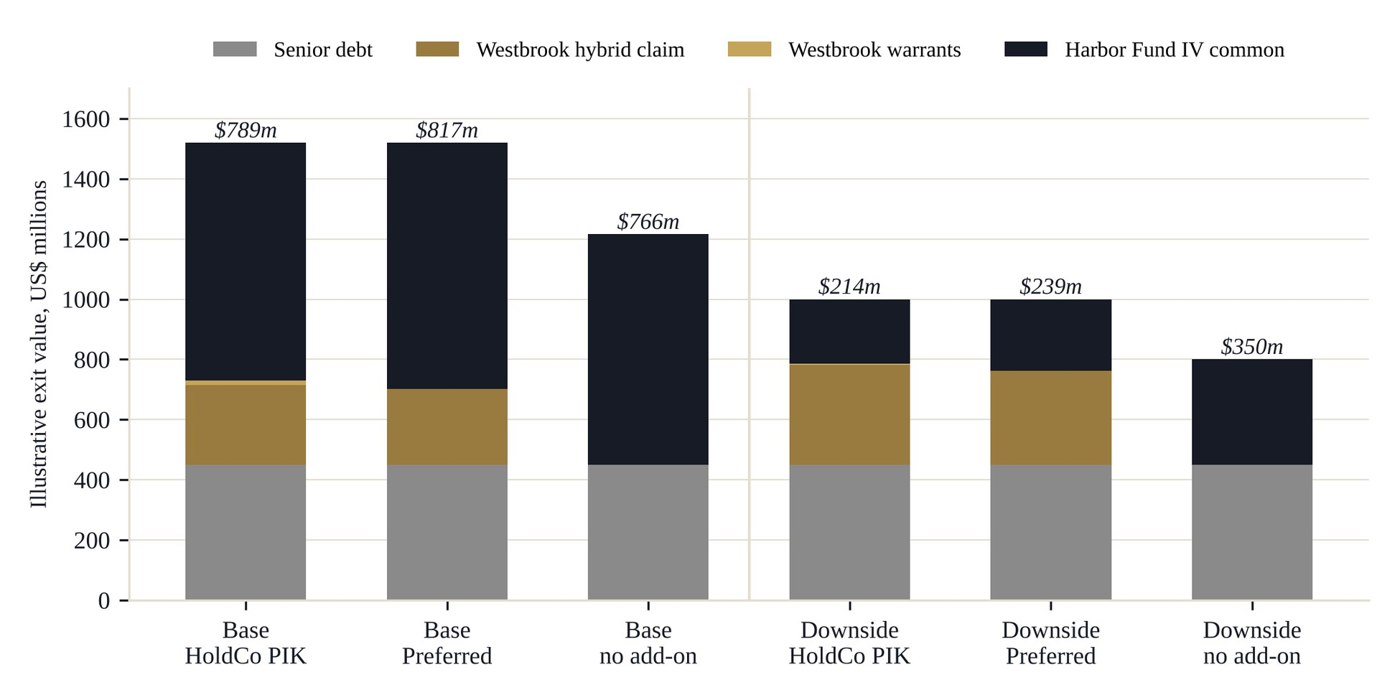
Exhibit 9. Exit-value illustration: value split by claim, base case and two-year-late downside (US$ millions). Labels show Harbor Fund IV’s common equity value. Interim cash flow and fees are excluded in every case. Source: La Presa model.
The usual reason to choose the note is the interest deduction. Here it is worth very little. With the warrants allocated, the note yields 13.2%, which makes it an AHYDO: $19.4 million of its interest is lost permanently, and $105.9 million waits until repayment. Senior interest of $36.0 million already fills nearly all of Northline’s §163(j) capacity, which the One Big Beautiful Bill Act restored to an EBITDA base. In the exit year the room is about $9.6 million, so about $2.0 million of tax is saved currently; the rest becomes a carryforward the next owner will discount. Even if fully usable at once, the deduction would be worth $22.2 million. Section 279 may cut it further: Northline’s year-1 EBITDA covers its interest about 2.3 times, below the statute’s 3-times line. Against $27.7 million of extra coupon and warrant value, preferred is the cheaper instrument, and the result holds across the sensitivities in the full alert.
05 What the investor’s LPs keep
The holder’s side reverses the analysis. Westbrook is a partnership, so what matters is the tax profile of its LPs.
| Westbrook LP | Note and warrants | Preferred |
|---|---|---|
| Pre-tax return, base case | 13.33% | 11.00% |
| U.S. individual, top bracket | 8.11% | 8.38% |
| Non-U.S. LP, qualifying portfolio interest, no treaty | 13.33% | 7.70% |
| Non-U.S. LP, 15% treaty dividend rate | 13.33% | 9.35% |
| U.S. tax-exempt, no acquisition debt | 13.33% | 11.00% |
Exhibit 11 (excerpt). Same deal, different LPs: after-tax annual return on each instrument, base case. Source: La Presa model; the full alert sets out every assumption.
For U.S. individuals the preferred comes out 27 basis points ahead after tax, even though it returns 233 basis points less before tax. For qualifying non-U.S. LPs, the note wins by 563 basis points. Westbrook’s LP base may decide which term sheet it offers more than Northline’s tax position does, and a sponsor who knows that can ask for the cheaper instrument and offer a blocker or a parallel note to the LPs who need one.
One more asymmetry belongs in the downside model. Holders pay tax on accrued discount and PIK dividends every year, and a total loss does not refund it. If Northline failed at year 5, a fully taxable U.S. individual LP base would already have paid about $48.8 million of tax on the note and $24.5 million on the preferred, and the loss that follows is generally capital, offsetting only $3,000 a year of ordinary income.
Our take
We are firmly in favor of capital solutions funds. They are the slug of capital that gets deals done between selling too early and borrowing too much, and at this scale they did not exist a decade ago. In our fictional case, Westbrook turns a deal Northline cannot finance into $23 million to $51 million of added value for Harbor.
But the market has borrowed its tax habits from the two businesses it sits between. Debt people assume the interest is deductible. Equity people assume the preferred is just a class of stock. Both assumptions can fail in the space between, and choosing a $150 million instrument for a tax shield worth $2 million at exit (and at most $22 million) is a costly habit. Sponsors should take a capital solutions fund’s money when the deal passes the slug test, then negotiate the form after modeling who receives the cash, who bears the tax, and what happens when the exit arrives late. Much of the tax plumbing is laid at the term sheet.
The full alert adds six real deals read for their tax shape, the complete floor and ceiling tables, the §163(j), AHYDO, and §279 arithmetic, a Monday-morning checklist for deal teams, and sensitivities. Download it here.
Selected research and primary authorities
Mayer Brown, Richard Murdoch, Mark Evans, Jonathan A. Dhanawade, and Electra Callan, “Hybrid Capital: Structuring for Downside Protection and Upside Participation,” Capital Solutions Insights series, November 12, 2026. The prompt for this alert, and the source of its map of protections and upside mechanics; we are grateful for its clarity. Mayer Brown, “What Is Capital Solutions? Bridging the Gap Between Debt and Equity” (September 2026) and “The Rise of Private Capital: Capital Solutions and the New Architecture of Credit” (October 8, 2026), the best short account we know of why borrowers call capital solutions funds and what those funds expect in return.
Apollo releases and third-quarter 2026 earnings call; Intel Form 8-K (April 8, 2026); Bayer and Apollo releases (July and September 2026); QXO releases and Forms 10-Q (2026); Prime Capital Financial and Carlyle (August 2026); Medallia (August 3, 2026); Alternatives Watch on GTCR (July 29, 2026); With Intelligence, Private Credit Outlook 2026; Dechert LLP, “Preference Given” (August 2026); Bain & Company, Global Private Equity Report 2026. Ryan Bailey, Connie Cunningham, and Megan McLaughlin (BDO), “Sec. 163(j) After OBBBA: Leveraging Cost-Recovery Accounting Methods,” The Tax Adviser (May 2026), a clear and practical guide to planning under the restored limit. IRS, Rev. Rul. 2026-21 (November 2026 AFRs). Myron S. Scholes et al., Taxes and Business Strategy, 5th ed., ch. 1, p. 20.
Important notes
This alert addresses U.S. federal income tax only. The Northline case is hypothetical; its parties are fictional and its figures are rounded illustrations built on stated assumptions. The tax questions attached to real transactions are ours and do not suggest how any issuer or investor treated or should treat a transaction.
This client alert is for general information only. It is not tax, legal, investment, or accounting advice. Consult your own advisers about your particular circumstances before acting on any matter discussed here. Questions: Carlos Schmidt, CPA, La Presa Partners LLC, carlos@lapresallc.com, (917) 558-6393.
C . A . S .
Download the alert (PDF, 564 KB)
Client alerts go out about once a week.
This alert is for general information only and is not tax, legal, investment, or accounting advice. Consult your own advisers before acting. Carlos A. Schmidt, MBT, MBA, CPA · carlos@lapresallc.com · (917) 558-6393.